CorporateMOM e = mc^2 THE Corporate Mantra for Digital Age
Video:
Podcast mp3
Podcast Episode 64
CorporateMOM
e = mc^2 THE Corporate Mantra for Digital Age
Consequent to the VC Firm’s request for an SOS Governance DD, I prepared this note for general knowledge for Corporate understanding. I have committed to the Ramanathapuram GDDP Development Model out of India’s 806 Districts. There are 805/806 that are yet to be taken. In this context, companies are at the bottom of the pyramid. This note on ‘e = mc^2 THE Corporate Mantra’ for Digital Age should help company managers to focus on ‘unleashing other people’s energy’. Take a look.
The three laws that corporate shall inherit from Mass and energy have an equivalence. Law 1: Energy is liberated, Matter; Law 2: Matter is Energy waiting to happen. Law 3: Antimatter when it collides with Matter forms pure Energy. Take a look at the following slides: 1. Change Your Organization Structure. Realize your Debit – Credit Organization Structure is unfit for the Digital Age. Drop it. 2. Budgeting for Roadmap 2047. Companies are at the bottom of the Corporate – GDDP – GSDP – GDP – GNH Pyramid. 3. Knowledge Database – Roadmap India 2047 consists of the Agriculture Sector, Industry Sector, Cultural Heritage and Services Sector.
Cultural Heritage leads to GNH – Gross National Happiness Index integrating with Economic Development.
Note: Your Debit – Credit Organization Structure limits your Knowledge Database of your company. In reality, your knowledge Database is empty. 4. CREAM Ratings – Corporate Governance, Risk Management, Earnings, Accounting Quality, Management Quality: A leaf out of my GE Case Study on Corporate Life Cycle. Get yourself rated by CREAM Ratings. A matrix case study on HUL followed by two pages of Index of Inactivity by Process Area and Index of Inactivity by Resource Area. 5. SOS Governance Standards. Currently, you are touching upon only the Law 2, P&L, and Balance Sheet. Companies must realize they are only spot-jogging. My advice please hear me out. 6. Response Report: Two slides on my post response from Big Firms. Apply e = mc^2 to know how your energy level is critical for Corporate Growth. 7. Countries: I have created a good interest around the globe. Check what Prof. Leif Edvinsson says.
Companies are coming to me for my guidance on preparing the SOS Governance DD Strategy Plan 2030. You are welcome.
CorporateMOM Ramanathapuram District GDDP – GDH : Development Plan 2030-2047 A Preview
Video:
Podcast mp3
Podcast Episode 63
CorporateMOM Apply Ramanathapuram District GDDP GDH Development Plan Model 2030-2047 to all Districts
I quote from: DISTRICT SURVEY REPORT
Q: This area is dry and backward and known as East Ramanathapuram, comprising the taluks Thiruvadanai, Ramanathapuram, Kadaladi, and Rameswaram. This region is called the coastal region of Ramanathapuram district. It has all the depressing features such as poor soil, frequent droughts, absence of irrigation systems, precarious farming, etc. This area is much more backward and underdeveloped than any other district. Mainly in coastal areas, the terrain is completely a sandy tract with very little scope for agriculture. UQ
1. With this in the background, I give my study on Ramanathapuram District – Agriculture, Vaigai River, Vaigai Dam, Ramanathapuram Big Tank, Mugavai Tank, and the Hard-working farmers from Punjab who have turned a ‘deserted or abandoned’ arid farmland into an oasis of lush green orchards in drought-prone Ramanathapuram in southern Tamil Nadu.
2. Establish [back] Tamil Sangam at Ramanathapuram.
3. Mining and Quarrying, critical metals, minerals, and Thorium exploration.
4. Fisheries
5. Rameshwaram and Rameshwaram Twin City Kashi.
6. Ramanathapuram District GDDP – GDH Development Plan 2030-2047: GDH Gross District Happiness Index.
9. The Ramanathapuram Model is an all-community Development Model.
This is a preview, of what I intend to submit to the newly elected Member of Parliament by June 4th. I recommend Ramanathapuram District GDDP – GDH Development Plan 2030-2047 for all the 806 districts of India.
CorporateMOM Rebuild Sri Rama Setu, Multiply Ramanathapuram GDDP Entrust to the Lok Sabha MP Get Modi’s Guarantee.
Video:
Podcast mp3
Podcast Episode 62
CorporateMOM Rebuild Sri Rama Setu, Multiply Ramanathapuram GDDP Entrust to the Lok Sabha MP Get Modi’s Guarantee.
Since the Industrial Revolution, corporate history has seen enormous growth in freedom of enterprise, economic prosperity, innovation, and technical and intellectual advancement. We are looking at the capability model in the industry. But, it has also furthered the stoking of greed, a slow and sure decay of morality and social order culminating in high unemployment and misery for mankind. We are looking at the burden on society. The first part is Construct Values and the second is dismantling what is worthless.
I present here, Rebuild Ram Setu, Multiply Ramanathapuram GDDP – Gross District Domestic Product, Entrust to the Lok Sabha MP, Get Modi’s Guarantee.
For the first part let corporate look into the opportunities in districts that are 806 in total, in India. AI must look into the abandoned districts of India, not just the giant companies. That is where the future is for corporate development, not the big companies. Mission 2047 for $20 trillion is not replicating the current companies. New faces would emerge, mainly from the districts.
I shall provide the Blueprint for Ramanathapuram District. I hail from Ramanathapuram. This can be extended to other districts by interested persons. What I have seen from the current scenario of Ramanathapuram District is indeed pathetic. Any interested, well-placed, and educated person who chooses to go to any of the 805 home districts will find the scenario identical.
The second part is more difficult – deconstructing what is worthless. Deconstructing what is worthless from .pol is the current outlook of the Modi-3 agenda for the next 5 years. What an elected Lok Sabha MP can do is the critical study I bring in here. Ramanathapuram has a great contribution in this respect. You will find it interesting.
CorporateMOM Action plan 2030 – 2047, District-wise GDDP build-up. GROSS DISTRICT DOMESTIC PRODUCT, Ramanathapuram District.
Video:
Podcast mp3
Podcast Episode 61
CorporateMOM Action plan 2030 – 2047, District-wise GDDP build-up. GROSS DISTRICT DOMESTIC PRODUCT, Ramanathapuram District.
I am proposing creating a blueprint for increasing the GDP of my home district Ramanathapuram to $30 billion by 2030, from around $3 billion currently.
– I want to connect with the local Members of Parliament to provide this blueprint and get their support for implementing it. – I encourage professionals working in big companies to go to their native districts and create similar blueprints for GDP growth for their home districts. – There are 806 districts in India and I want each district’s GDP growth blueprint created and driven by people originally from those districts. – I emphasize that individuals can influence their Members of Parliament more than big companies can, and they should leverage the District Development Plans implemented. There are 543 MPs and 806 Districts to be cared.Podcast #61 – Action plan 2030 District-wise GDDP build-up
Sector-wise GDP in India 2022-23 2030-31 Action plan 2047 – State-wise GSDP build-up
Video:
Podcast mp3
Podcast Episode 60
Sector-wise GDP in India 2022-23 2030-31 Action plan 2047 – State-wise GSDP build-up
Executive Summary
1. I am worth something now:
To quote Vincent Van Gogh, “If I am worth anything later, I am worth something now. For wheat is wheat, even if people think it is a grass in the beginning.” My theme for 2024 is ‘unleashing other people’s energy’. I have published several papers such as ‘ERP is passé. Embrace EPP- Effort per Person.’ In this podcast episode, I state, that India’s economy will see accelerated growth from 2024 to 2030 to 2047, but this requires unleashing the energy of all employees. That’s the theme.
2. GDP projections for India: I discuss the GDP projections for India in 2030-31 across agriculture, industry, and services sectors. Agriculture and Industry are given a markup while public administration is given a markdown. I explain how Daily growth rates (CDGR) and daily reduction rates (CDRR) are important to achieve 2030-31 targets starting April 1, 2024.
3. List of Indian states and union territories: I give a breakdown of GSDP for various Indian states, noting some discrepancies between different data sources. I recommend that the top 6 states, target reaching $1 trillion GSDP, using Gujarat as an example to reach $1.5 trillion by 2030. I advocate reducing bureaucracy and public administration to enable the growth of companies and the economy. I propose a methodology to measure individual and company contributions to state GSDP based on physics, quantum physics, and metaphysics, the Science of Management Operating Systems. Track innovation, and measure performance.
4. Agriculture: To reach the agriculture goal, FPOs need to be connected with farmers and given production targets, utilizing innovations like automation, Drones, and AI.
5. Industry: For industry, companies like Tata committing large investments can be tracked to measure progress. Innovation and technology utilization are key.
6. Services: For services, expenses must be monitored and optimized, including investments in things like SAP or AI.
7. The Methodology: The methodology used for Gujarat’s GSDP planning should be replicated in every state to reach India’s $5 trillion economy target by 2030. Planning must start by April 1, 2024.
The ides of March has gone, Get ready to: Kickstart Budgeting 2024-25, 2030-31, 2047-48 Now, Now, Now. Budgeting for Roadmap India 2047 CorporateMOM
Beware the ides of March Kickstart Budgeting 2024-25, 2030-31, 2047-48 Now, Now, Now. Budgeting for Roadmap India 2047
1. Beware the ides of March: This time of the year, companies frantically try to reach targets set a year earlier. CorporateMOM looks at the futility of our budgeting exercise that truly had stunted our growth. Looking ahead “Kickstart Budgeting 2024-25, 2030-31, 2047-48 Now, Now, Now”, is what CorporateMOM calls for a complete change in the Annual Budgeting we do.
2. Roadmap India 2047: Prime Minister Modi has set a target of $5 trillion and $20 trillion GDP in the next two decades for India to reach the heights of a developed economy among the comity of nations. Budgeting exercise is a tame affair. That’s what CorporateMOM cautions, Beware the ides of March. Having set a GDP Target of $20 trillion by 2047 if companies follow the same Annual Budgeting exercise then we would all be hitting the 15 of March of 2048 the same way. Companies must change their methodologies.
3. Budgeting for Roadmap India 2047: Budgeting for 2047 Now, Now, Now is different from what we have been doing for the last 6 decades. Sector-wise GDP in India [2022-23] Agriculture, Industry, and Services are analyzed and projected to 2030-31 figure to match $5 trillion GDP. If India’s 2030, and 2047 GDP figures are to be achieved safely then every entity in all the three sectors referred needs to participate fully.
4. Budgeting for Creative Process and Action Process: Areas that are critical for India’s target of 2047 are analyzed as the Creative Process and the Action Process. As an example, Global Production of selected Energy Transition Metals 2021-40, scaling up from $4.9 trillion in 2018 to $13 trillion in 2040, and at the same time Fossil Fuels dependency is reduced from $70 trillion to $19 trillion in the same period. This is huge. Two important formulae I deal with in my CREAM Report-analytics, are 1. CAGR to CDGR and 2. CARR to CDRR [RR being Reduction Rate and D Daily Rate] which are applied for all three sectors to move forward with a Budgeting System of Daily Growth Rate, like playing an ODI in Cricket. Set the targets for 2030, and 2047 and keep tracking by each Entity, everyday.
5. Country Ratings: Corporate Ratings are by the two processes – Creative and Action. There are no separate ratings for a company but performance ratings of individuals add up to company ratings. Similarly, Country ratings are arrived at by the performance ratings of each entity.
Links are given to Deriving Everlasting Corporate Metrics & Benchmarks, ERP is passé, Embrace EPP- Effort per Person would assist companies to align with the Roadmap India 2047.
So Beware the ides of March, date companies must change, change, change the current ex-post-facto analytics of adverse variances. EPP Effort Per Person will bring in the energy force to the set targets, be it critical metals or 3-nanometer chip.
Deriving Everlasting Corporate Metrics and Benchmarks CorporateMOM
Video:
Podcast mp3
Podcast Episode 58
Dynamic GDP – GNH – Database Systems, CorporateMOM
I’d like to reiterate what I have talked earlier about the flat organization structure that we have, everybody, in every company. We are all on the debit and credit Organization structure. To make it dynamic we require a different structure. That’s what CorporateMOM stands for: establishing the connect between the entity and society. Society has to be brought in. So I’m giving here the Six Limbs and Four Auxiliary Limbs of a Corporate Body, which is the Organization structure that gives a corporate body the human form.
Six Limbs of the Corporate Body are:
1. The nose is intangible. It converts mass into pure energy. 2. Mouth is the grammar of the Corporate Atomic Structure. 3. Feet are the measurement through Powerful Metrics. 4. Ear is the dictionary of the learning management system (LMS). Project ELITE 5. Eye is the Long-Range Planning and Short-Range Action— CAGR brought to CDGR, CARR converted into CDRR Daily Reduction Rate. 6. The hand is the work.
Four Auxiliary Limbs of the Corporate Body: I. Explication of corporate laws and management quality II. Science of reasoning—sustainability of efficiency III. Ethical responsibility—Sustainability of Value System IV. Strategies—sustainability of profits and growth
In this episode I refer to #3 Feet – Metrics and Benchmarks, given as to how they are obtained as an everlasting tool of measurement for companies. I also refer to policy accidents and policy politics. Where does Google Gemini fiasco fit in as well as where does Harvard DEI fiasco fit in?
We have seen 1. ERP is passé. Embrace EPP- Effort per Person, as well as 2. Company SOS Governance Ratings. Metrics and benchmarks are critical for the success of EPP. I mention India’s GDP Plan of $20 trillion by 2047 and how this will be met by syncing with the EPP of individual companies Plan of Action.
Dynamic GDP – GNH – Database Systems, CorporateMOM
Video:
Podcast mp3
Podcast Episode 57
Dynamic GDP – GNH – Database Systems, CorporateMOM
SOS Governance Standards Certification Scheme for Audit, IT, Consulting, Companies, Universities, enabling, GDP-GNH, Combo Builder
Another interesting one from CorporateMOM. Since attending the Vibrant Gujarat 2024 I have been publishing a few posts well received by many firms. As a summary of what I have been indulging in, I present here how I intend to take it forward. A short review of relevant posts to: 1. audit:- GE Case Study Deconstruct what is valueless: What steps GE has taken internally since KPMG was shown the door by the shareholders? 2. IT – ERP is passé. Embrace EPP- Effort per Person. The knowledge base of the conduct of people within a company is important. It has a technical advantage over AI, which IT companies should take note of. 3. Consulting: Internal Consultants: Promoting Consulting Firms being equipped with SOS Governance is my priority. Consulting Firms big or small cater to industrial development and growth. 4. Companies: I earmark two posts for companies: 1. Corporate Life Cycle – Yaqui way of knowledge, and 2. SOS Governance Ratings. For the Corporate Life Cycle, I have suggested studying the Yaqui Way of Knowledge. At a time when India is embarking on a major economic revival, we lack the basic knowledge base as to how a company without hindrance moves forward. Companies have to take note of SOS Governance. 5. Universities: I state in this post: CorporateMOM ~ I 4.0 Operation COURAGE – Corporate & Universities – Revitalizing – Advanced – Global – Economy Advanced Global Economy warrants a modern-cum-corporate civilization. I look at the Universities and Companies as to how they are collaborating for this purpose. 6. GDP – GNH Combo builder. CorporateMOM decodes the Indian Statistical Ego-system Establishing a Dynamic GDP – GNH Database System. A lot of changes need to be made in our statistical data collection and presentation. I recommend statistical data that gets added of a single farmer’s produce to the FAO stats for a country, on the go, Daily.
ERP is passé. Embrace EPP- Effort per Person – CorporateMOM
Video:
Podcast mp3
Podcast Episode 56
ERP is passé. Embrace EPP- Effort per Person.
1. Capability of humankind,
2. Metaphysics: Immanuel Kant (1724–1804) raised the question of whether a science of metaphysics with a logical structure, like that of the well-established mathematical and natural sciences, was possible. CorporateMOM has made it possible.
3. Human capability 4. Accounting and Accountability
5. Return on THE Intangible Return on THE Intangible = (Action or Inaction)/THE Intangible. The Equation throws out a binary value of 1 or 0.
6. Valuation, It’s the mistake of big Investors valuing or accepting a valuation of a startup at an exorbitant valuation, saying we enter at $1.5 billion and exit at $6 billion, with a mere Fin DD. If Investor Assurance is warranted by the investors they must pursue SOS Governance DD, for startups to other areas of investments. Current valuation methods must be replaced by SOS Governance – Performance Valuation at each step of value addition.
7. Embrace EPP – Strategy Plan 2030 System
What ails corporate: The Corporate is the one wing, society the other, and the government the main body, as the SOS plane is trying to fly but stuck on the tarmac. What ecosystem corporate is entangled with? What can society do about it? What do the governments do to take off? The ecosystem, corporate is faced with is as age-old as Alexander the Great set: Colonization is more secure and profitable, and territories gained by any means, justifying the conduct of men in charge. Governments are formed in the same pattern, in Genghis Khan style. Society wallows in misery and continues to be. These are the main posers in my mind. Two compelling reasons I bring to Society to be aware of the solutions I offer. 1. Break the current ecosystem, [I call it an ego-system] and 2. fuel the energy force for the SOS Plane to take off. [Book Extract – CorporateMOM]
EPP is the energy force needed to fuel the SOS Plane to take off.
I am willing to sit with the Investors to arrive at an SOS Governance DD for Byjus, as I have seen that Byjus has shown keen interest in my posts. An SOS Governance Strategy Plan 2030 could rebuild Byjus as well as the Investors getting an Assurance. This exercise could be the change manager critical for the startups.
There were several papers well received by major Audit, IT, and Consulting Firms. Continuing on the Constructive Collaboration I am looking at the Rating System for qualitative elements of management. Out of 200 process blocks 188 constitute qualitative elements of management that are there but in limbo, uncared. Only 12 quantitative elements are shown under the P&L and Balance Sheet we keep hammering around. Any Tom, Dick, and Hindenburg can take any major company to the cleaners upsetting a major stock market. The fault lines are too apparent. We have seen how VC Funding has derailed the startups’ initiatives. At a time when India is embarking on a major economic revival, we lack the basic knowledge base as to how a company without hindrance moves forward.
Corporate history since the Industrial Revolution has been an enormous growth in freedom of enterprise, economic prosperity, innovation, and technical and intellectual advancement. We are looking at the capability model in the industry. But, it has also furthered the stoking of greed, a slow and sure decay of morality and social order culminating in high unemployment. This is the cause of instability.
In episode 55 “Company SOS Governance Ratings – CorporateMOM” I offer a rating system with everlasting metrics and benchmarks. Whether a startup looking for VC Funding for the startup or a company going for private equity or a major company is going for an M&A, the one that is common and would decide the success of the initiative is SOS Governance DD. Without Governance DD with a mere Fin DD, the Investor Assurance doesn’t happen. Investors have to insist on SOS Governance DD.
What gets measured, gets managed is at the top of the 5 Principles IBCM enunciates. IBCM is Inactivity Based Cost Management. Activity has a cost incidence whereas inactivity has a cost consequence. Measure cost consequence Now, Now, Now, is the theme. I am giving in this episode 55 qualitative elements of process blocks 158 of them that are critical for measuring and assessing a company’s progress. The future of companies depends on these SOS Governance Ratings. Do not limit your ERP to just quantitative expand to include qualitative elements, SOS Governance Ratings System enables.
EPP Effort Per Person is the goal set for everyone, is the goal congruence.
If you take one big conglomerate like Reliance, Adani Enterprises, Tata Group or TVS Group the qualitative elements are common for the group whereas quantitative elements are special to respective business segments. The qualitative elements are common on a national grid of governance. Stock markets would not be greatly affected by the adverse variance in quantitative aspects but in qualitative aspects. That assurance of CoBP – Code of Business Principles adopted by individual companies would take them ahead of foreign competition.
Investment opportunities for Indian companies grow exponentially. Consulting firms can do their bid to promote such companies. I shall stand by the certification scheme for SOS Governance Ratings. Companies be certified.
Constructive Collaboration – CorporateMOM with a GE Case Study
Video:
Podcast mp3
Podcast Episode 54
Constructive Collaboration – CorporateMOM with a GE Case Study
Bring the abstractions into reality, acknowledge value where value is due, and deconstruct what is valueless.
CorporateMOM looks at GE, based on the article “GE divorced from KPMG after 111 years” by Iridium. By 2018 GE had become a byword for corporate scandal, accusations of corruption, regulatory sanction, and illegal accounting practices. Truly shocking to me to read the article. I raised the issue of “Deconstruct what is valueless” and what steps GE has taken internally since KPMG as Auditors had been replaced.
The report by Iridium – This cozy relationship between auditor and audited is under increasing scrutiny. It simply does not fit with the current mood of regulatory governance to keep such an important relationship unchallenged and intact for so long taken note of, vis-a-vis SOS [Subject-Object-Self] Governance Due Diligence.
June 22, 2020, is the day KPMG left the space for Deloitte that I mentioned on “Construct Values” with an IFRS mission statement – The purpose of international accounting standards is “to develop IFRS® Standards that bring transparency, accountability, and efficiency to financial markets around the world.
Referencing Prof. Ashwath’s The Corporate Life Cycle I move on to ‘The Role of Auditors’ and offer the SOS Governance Standards. The Corporate Life Cycle brings up the status of a few companies under each stage of development and arrives at the status of GE and Ford as in the decline stage. These companies LIME, AI, TESLA, Uber, Netflix, Nvidia, Facebook, Google, Coca-Cola, and Walmart besides GE and Ford, I reconstruct under CREAM Ratings [ Corporate Governance, Risk Management, Earnings, Accounting Quality, Management Quality] scan how it would be by SOS Governance Standards. Is an interesting analytics offering solution to the first question I raised: what steps GE has taken internally since KPMG as Auditors had been replaced?
In our backyard, we find BDO has taken over as the Auditors of Byjus. What steps Byjus has taken and what steps BDO has taken?
I have also suggested the false notion of an Auditor resolving many an issue of such companies the statutory auditor post be scrapped and let the management take the responsibility of signing their annual accounts. Mind you, SVB and FTX had a statutory auditor.
Primarily several consulting firms have graced my articles on LinkedIn. I am revisiting my objectives as stated in my post on the Vibrant Gujarat 2024 Agenda that are:
The topic of course is Constructive Collaboration. Consulting firms and companies shall look into my analytics and we can work together to take it forward with an emphasis on Internal Consultants. I have expressed my limitations as well as my IPR’s capability.
Two areas of interest 1. Forensic University and 2. CAG – Comptroller and Auditor General of India will be on my radar next.
Theme: Content Future Establish SOS Governance Now, Now, Now Unleashing Other People’s Energy
My trip to Ahmedabad attending the Vibrant Gujarat 2024 was deliberate.
Herein I present the highlights of what I saw during the 3-day event.
1. The large exhibition center wherein 100s of companies and organizations have taken great interest.
2. Dholera Smart City is one of its kind, which has been envisioned by Prime Minister Mr. Modi as a city that is twice the size of Mumbai and six times that of Shanghai.
3. The interest a senior person from HAL took considerable interest for the kids was indeed heartwarming.
4. AI is the talk of the corporate universe.
The content is the future and my purpose is establishing SOS Governance, Now, Now, Now.
Constructive Collaboration
I arrived at an understanding to promote CorporateMOM in establishing SOS, [Subject – Object – Self] Governance Standards among Companies, Banking, and Institutions, forming a non-exclusive consortium of workaholics.
The areas of collaboration stated therein are:
1. Study of Forensic Audit: After the meeting at the venue with National Forensic Sciences University | NFSU officials. vis à vis SOS Governance Standards,
2. Societal Changes: We met at the Vibrant Gujarat Venue IIM-A and Shipping University. Societal Changes and Project Development ~ FEC [Fiscal-Ethical-Co-Responsibility] Report.
3. Dholera Smart City: Infrastructure Development: vis à vis Methodology adopted by CorporateMOM.
4. CAG – CAG to be SOS Governance Standards leading to prepare an FEC Report to every government department appropriate.
5. Major Consulting firms’ response to CorporateMOM Vibrant Gujarat 2024 posts. For constructive collaboration.
6. Unleashing other people’s energy,
7. The five principles of IBCM – Inactivity-Based Cost Management furthering knowledge base with FEC Framework.
Podcast Episode #20 on Women Empowerment [4’ 52”] I posted on 4 January 2023. Good start for 2023. I am giving here the same. Take a look, considering what the US is hotly discussing on Claudine Gay, President of Harvard University, DEI I have put forth in this Episode #20.
On 24th of December 2023, Podcast Episode #50, CorporateMOM Corporate Life Cycle Seeing through the Prism of Yaqui Way of Knowledge I posted on LinkedIn. So, 31 posts on LinkedIn, as well as my website, including the announcement of my second book – CorporateMOM Sustainability of Corporate Stability – marked my work satisfactorily during 2023. These posts attracted many companies such as #accenture, #kpmg, #kpmgindia, #sganalytics, #salesforce, #ibm, #ey, #deloitte, #infosys, #tcs, #persistentsystems from where many within had a look at my posts some exceeding 100 in the same company. The topics covered by me you will find interesting.
For Women’s Empowerment, I have shown photos of Israeli soldiers. Israel is an amazing country of men and women and I wish them a very happy 2024. They deserve to win and they will defeat Hamas.
Preview 2024: “unleashing other people’s energy”.
For Preview 2024 my theme is “unleashing other people’s energy”.. I am presenting an extract from Episode #50 CorporateMOM Corporate Life Cycle Seeing through the Prism of Yaqui Way of Knowledge. I have also given Country Views for the year 2023 in descending order of viewership which gives me a greater satisfaction as many small countries have evinced interest. The Blueprint given herein for “unleashing other people’s energy”. would provide the methodology for any country to move forward confidently.
For preview 2024 “unleashing other people’s energy”, I have selected Maryada Purushottaman Ram. Maryada Purushottam is a Sanskrit phrase in which “Maryada” translates to “honour and righteousness”, and “Purushottam” translates to “the supreme man”. The phrase when combined refers to “the man who is supreme in honour”. It also means the best man who practised righteousness until he perfected it.
Levina while giving this photo of Ram in X says it’s a month dedicated to reading Ramayan in every house in #Kerala. The photo of Ram walking majestically with the monkeys told me a lot about “unleashing other people’s energy”. These monkeys had built the bridge Ramsetu between India and Sri Lanka visible even today. So would be the leadership of companies to please “unleash other people’s energy”.
CorporateMOM Corporate Life Cycle Seeing through the prism of Yaqui Way of Knowledge
Podcast mp3
It was quite nice to watch Prof. Ashwath Damodaran, The Stern School of Business, speaking on an interesting subject “Corporate Life Cycle – Growing Up Is Hard To Do”.
I could instantly connect Prof. Aswath to Carlos Castaneda’s The Teachings of Don Juan: A Yaqui Way of Knowledge.
Prof. Ashwath takes you from the start-up stage to young growth to high growth to Mature Growth to Mature stable to a stage of decline for corporate. Whereas Don Juan teaches how a man has to set an operational goal, as Carlos Castaneda the research scholar apprenticing under the great Mexican Red Indian, how to understand that operative order, one has to understand its objective: man of knowledge.
CorporateMOM looks at Prof. Ashwath’s Corporate Life Cycle vis-a-vis the current ecosystem prevalent in companies. Note the difference, for Prof. Ashwath Object is the constant whereas for Don Juan the Subject is the constant. It’s an interesting contrast that defies the conclusions drawn by Prof. Ashwath, as CorporateMOM offers how to restructure organizations and rebuild companies in decline.
This is my Podcast Episode #50. I am happy every one of them has come out very nicely. Thanks to the hundreds of viewers from all over the world.
CorporateMOM Resolves the equation (AI+HI) = Generative AI With a case study on IBM
Podcast mp3
CorporateMOM Resolves the equation (AI+HI) = Generative AI With a case study on IBM
In response to the LinkedIn NEWSLETTER “AI in Action from IBM” I present here my analytical report on “Keeping up with generative AI” a video presentation by Kate Soule from IBM Research. I find this subject matter quite timely and interesting on the subject of Generative AI.
Kate talks about AI Academy. Why foundation models are a Paradigm shift for AI Chapter 1 – Introduction to generative AI models, Chapter 2 – Getting started with generative AI, and Chapter 3 – The platform approach for model management.
A summary of her talk, with the help of an AI, I present here:
1. large unlabeled datasets, 2. build expertise in Generative AI, 3. Update models regularly, 4. Leverage a robust AI platform with governance tools, 5. While complex, Generative AI will help businesses innovate.
And how CorporateMOM looks at the several points raised therein specifically on Generative AI and what CorporateMOM offers in return.
CorporateMOM concludes:
1. Leverage AI Platform: Generative AI – MeRIT Governance Framework
Your database is full, due to Traditional AI – Artificial Intelligence: Your Knowledge Base is Empty, which means you need HI – Human intelligence: Traditional AI + HI gets you Generative AI. Check Generative AI – MeRIT Governance Framework as given herein.
Traditional AI helps Financial Leverage and Operating Leverage that are static. Whereas Generative AI helps you with SOS Governance Leverage which is dynamic.
2. CorporateMOM brings in the Ecosystem from Nature, with everlasting Metrics and Benchmarks for Corporate Management Operations.
Generative AI can ignite ecosystem innovation by tapping into the collective brainpower of all organizations quickly and easily. [IBM-IBV]
What CorporateMOM suggests for Generative AI is to ignite the Ego-system of companies to reach the ecosystem set by Nature. Generative AI will continue to be a reactive machine but transform as IBM-IBV says “Generative AI is unlike any technology that has come before.”, by collaborating with HI.
I liked this study of IBM Research as well as that of Accenture. Generative AI will rule the roost in Corporate Management Operating Systems. Individual companies shall use it in their intranet and develop collectively as IBM states collective brainpower to trigger a national grid of governance. Thanks to CorporateMOM, thanks to Generative AI.
CorporateMOM – AI Copiloting ABC of SOS Governance – AI application for Auditing, Banking, Certified Corporate Governance – RFP
Podcast mp3
Video:
AI is THE WORD today. Rishi Sunak, Elon Musk, Google, and Microsoft & all are talking about THE WORD. No escape. THE WORD is that it is going to make redundant millions of people now employed in all and sundry jobs, particularly the AI telemarketing robots. Welcome. How good I feel to talk to a robot. No point in my getting angry.
The next in line are the Accountants and Auditors as Frey, and Osborne, predicted in 2013 with a probability of 0.94, only next to Telemarketers at 0.99.
What do I do? Do I welcome it as I have done with the Telemarketers?
In this presentation AI application for Auditing, Banking, Corporate Governance – Certified, I am discussing the same, whether Accountants and Auditors be done away with.
I conclude, that it is not AI that is triggering the collapse of the auditors but the harakiri of the auditors themselves. In this presentation, I reiterate Auditors are the only homogenous group focusing on Ethical responsibility and no other. AI is not governed by any Statutory Body whereas Auditors are. Auditors shall take note of it. It is imperative for the growth of the global economy Auditors report on the governance of a company. Let us find out whether AI [Artificial Intelligence] or HI [Human Intelligence] succeeds.
Let us strengthen the hands of the Auditors who certify SOS Governance Standards.
CorporateMOM – ABC of VC Funding – Troika of Entanglement – Auditors, Bankers, Companies.
Podcast mp3
CorporateMOM – ABC of VC Funding – Troika of Entanglement – Auditors, Bankers, Companies.
Another interesting and useful analytics from CorporateMOM is now on VC Funding. I am looking at length, some of the unicorns that have gone sour. But the troika of entanglement engages one to know not to consider a company in isolation. A mere P&L and Balance Sheet alone has no meaning.
Entanglement: An entangled system is defined as say, the constituents are not individual particles but are an inseparable whole. In entanglement, one constituent cannot be fully described without considering the other(s). Troika of entanglement explains how qualitative elements of management that are part of inseparable all-inclusive elements, affect corporate stability. It’s like Superman’s ability is affected by Kryptonite.
Poor guys these unicorns. You pump them with a lot of money, with no governance and accountability, and make them splurge in gay abandon. The end result is the stalling of development in startups becoming a major force to be reckoned with, for the Indian Economy.
Auditors in this VC Funding scenario take the lead but are limited to a few. This is because VC Funding relates to a number of foreign LPs. VCs are the intermediaries between the startups and the LPs. An LP (an individual or an entity) is the money behind a VC or private equity fund. Currently, Governance lapses, and irregularities prompt LPs to drive changes in startup investments. Prompted by these reported instances of mismanagement and lack of oversight, LPs are driving changes in their relationships with VCs who recommend and manage their investment funds. Allegations of governance lapses or financial irregularities have surfaced at startups such as Byjus, GoMechaninc, BharatPe, Trell, Zilingo, Mojocare, Phablecare, and 4B Networks.
CorporateMOM looks at the maze of entanglement and offers insight into the governance lapses in all three players. Governance lapses or financial irregularities mean the existing Ego-System of ABC must get aligned with the Eco-System Nature provides. Time to change, a drastic change in the funding process. Surely it will shake all three players. Take a look.
CorporateMOM Travelogue – Locates THE ENERGY FORCE – For SOS Governance Due Diligence
CorporateMOM – SOS Governance Road to Readiness
CorporateMOM SOS Governance Road to Readiness
Project MeRIT Measure, Record, Implement, Track
1. IBCM Technology is a capability Model. 2. Establish Strategy Plan 2030 in a profound manner. 3. Measure all quantitative as well as qualitative elements of management. 4. Record current status 5. Implement Strategy Plan 2030 and Track Performance – Proceed from Current Status to Target 2030 – on a Daily Basis 6. With everlasting Metrics and Benchmarks join the certification scheme on the go. 7. Find out the amazing capability of your workforce – Measure Men Equity and Women’s Equity.
Takeaways
1. SOS Governance Due Diligence – Make it a habit. 2. Don’t wait for a mandatory ESG Governance notification for your company, be prepared. 3. Don’t wait for the funding process due diligence, be ready. 4. Don’t pay a big price for a vendor DD, DIY. 5. Pulsating energy force – converts the n-dimensional problems to n-problems of one dimension. 6. Make it simple.
The process has begun for a company with n-dimensional problems. [Show me a company without one?] Get in touch for your company.
CorporateMOM Travelogue – Locates THE ENERGY FORCE – For SOS Governance Due Diligence
Podcast mp3
CorporateMOM Travelogue – Locates THE ENERGY FORCE – For SOS Governance Due Diligence
Myself with my wife and children visited Tirukkadaiyur on 2nd October 2023 to celebrate my 80th Star birthday. Grand celebration by several families. The reigning Temple priest of the day invited us near the Sanctum Sanctorum. Gave us two garlands that my wife and I exchanged three times. It was a pleasant surprise with divine blessings.
It was a nice outing. My observation and learning I share with you.
1. Intangible, 2, Sustainability, 3. THE Energy Force.
How it helps service providers prepare a better Vendor DD, how Investor – Investee companies get a fair review of funding processes, and how ESG Governance Assurance is ensured. Lessons I learned during this trip I found very absorbing. Please have a look, at companies in any area of expertise.
CorporateMOM ~ KPMG ESG Maturity Report – Road to Readiness Recommends SOS Governance Due Diligence – Forward Thinking
Podcast mp3
I quote KPMG Report on ESG Assurance – CCPs – Critical Control Points
KPMG surveyed senior executives and board members with ESG reporting and assurance knowledge at 750 companies across industries, and global regions, with a mean revenue of US$15.6B.
66% of respondents say their firms must now report ESG data or will be required to soon.
Only 25% of companies feel they have the ESG policies, skills, and systems in place to be ready for ESG assurance.
65% of leaders see digital tools as key to being ready to obtain ESG assurance.
58% Of those least ready for ESG assurance, say it is challenging to balance ESG assurance goals with the profit expectations of shareholders.
Only 27% of companies have robust policies and procedures to support the development of their ESG disclosures.
Only 26% of companies have a clear audit trail to support their non-financial information.
CorporateMOM looks into the KPMG Report and analyses on two factors:
1. A case study on Investor/Investee companies, and 2. Why CorporateMOM recommends SOS Governance Due Diligence is a necessity in Forward-thinking.
KPMG looks at the Readiness of companies to the demands of ESG Governance. KPMG Report is of great quality. Adding value to it CorporateMOM finds it a pleasure.
CorporateMOM ~ SOS Governance Standards – A certification scheme for FEC [fiscal – ethical – coresponsibility] report – A Commercial proposal:
Podcast mp3
#CorporateMoM,
CorporateMOM ~ SOS Governance Standards – A certification scheme for FEC [Fiscal – Ethical – Co-responsibility] report – A Commercial proposal:
1. Further to CorporateMOM ~ AI RAGE [Revitalizing – Advanced – Global – Economy] – there have been a few inquiries. One from a Big 4 firm, via my associate, asking for a commercial proposal. My response and my commercial proposal, are now on.
2. I give herein briefly what and how CorporateMOM is of benefit to companies.
3. Emergent Property Phenomenon – Principles that lead companies to.
4. My commercial proposal includes my suggestions:
4.1 Internal Consultants: I suggest all companies and banking, Chartered Accountants, and Company Secretaries in practice as well as in job, create internal consultants. I encourage startups too. Internal consultants shall assist companies in preparing an FEC Report – Fiscal, Ethical, Coresponsibility Report – in their own workplace and to companies they act as professionals/consultants.
4.2 My proposal: 4.2.1 I shall assist the internal consultants with Project ELITE – Education, Learning, Implementation, Training, and Execution.
4.3 CorporateMOM FEC [fiscal – ethical – coresponsibility] report- Certification Scheme: 4.3.1. SOS Governance Standards enables the preparation of FEC [fiscal – ethical – coresponsibility] report. IBCM will primarily take responsibility for the FEC Certification Scheme. 4.3.2. The intention is to create certified SOS Governance personnel who are capable of certifying FEC Reports within an organization or client companies.
4.4 Job vacancies: 4.4.1. I would like the internal consultants to know that there are 200 process blocks in an organization, quantitative and qualitative. Only 12 process blocks are quantitative and the rest 188 are qualitative which are not measured. CorporateMOM enables measuring qualitative elements of management. That’s about 94% of the jobs in an organization are vacant. Fill the vacancies with the internal consultants.
5. Commercial Proposal: There are two CCPs – Critical Control Points – 1. Project ELITE and 2. Certification Scheme. 5.1. We are living on a DIY Planet. Companies should develop Project ELITE as a DIY.
CorporateMOM ~ AI RAGE [Revitalizing – Advanced – Global – Economy]
A Sustainability Report My findings: My proposal
#CorporateMoM,
It looks like AI RAGE is on. CorporateMOM ~ AI RAGE is the outcome of My Findings and consequently My Proposal on Operation COURAGE – Progress Report. COURAGE is Corporate & Universities – Revitalizing – Advanced – Global – Economy. Universities are the springboard for the future of the Global Economy. I peeped into one of the universities and what I found was truly remarkable. Almost all universities strive to create a platform for the Genzers to get into corporate offices and I have started with the leading light of the World.
What I stated in Operation COURAGE was that an advanced Global Economy warrants a modern-cum-corporate civilization. I look at the Universities and companies as to how they are collaborating with each other for this purpose. I had an opportunity to look into a University as well as companies dealing in AI.
Here are my findings and my proposal on how to take AI on RAGE – Revitalizing Advanced Global Economy.
Interaction with the university was good. I could talk to the Vice Chancellor who directed the Dean of the Business School to look into CorporateMOM. The Business School initiated “Artificial Intelligence and Frontier Technologies for Sustainable Business Transformation”. AI experts I could look at from a distant place in a webinar organized by the Business School was indeed noteworthy. AI is spreading its influence but as one of the AI exponents stated: “If you ask a data scientist, they’ll tell you how much percentage of their time is, spent towards cleaning the data massaging, because final services form, is are well known to have lots of unstructured data and to make any meaningful insight out of these unstructured data.” CorporateMOM deals with this statement squarely.
Here are My findings and My proposal on how CorporateMOM takes AI on RAGE – Revitalizing Advanced Global Economy.
While AI looks into 1 4.0 Advanced Digital Technology CorporateMOM recommends I 4.0’s mirror image of recording societal changes. Combined AI and CorporateMOM can sail easily into establishing an Advanced Global Economy.
CorporateMOM ~ AI will march forward for the goodness of humankind.
CorporateMOM ~ I 4.0 Operation COURAGE – Corporate & Universities – Revitalizing – Advanced – Global – Economy
#CorporateMoM,
CorporateMOM ~ I 4.0 Operation COURAGE – Corporate & Universities – Revitalizing – Advanced – Global – Economy
Excerpts
1. Corporate citizenship a GDP–GNH connect can get an entry. 2. Universities: 2.1. My work on Intellectual Value Capital is unique. 2.2 I am on a Mission Possible drive 2.3 Let me quote Allan Savory: 2.4 CorporateMOM – elaborates with a case study on Volkswagen. If Universities cannot debate this case study who else would? Gen Z is deprived of knowledge of corporate misbehavior. Free thinking is lost, for Universities. 2.5 Societal changes: I found some interesting factors with regard to Denmark. Also, I appreciate Copenhagen Business School. 2.6 Denmark should look into this. 2.7 In a world ruled by finance, intangible assets rather than real assets are the indicator of real wealth, is it? 2.8 What’s the solution? 2.9 I 4.0 is for Advanced Global Economy, and is not for the asking, as Universities have to emphasize recording Societal Changes. 3 Corporate -Mission Possible 3.1 In reality, Gen Z is the reverse mentor for corporate stuck with the Ego System. Realign your ERP 2030 to all quantitative and qualitative elements of management. 3.2 And take a look at Initiative Climate Bonds Certification. 3.3 So USD270bn has been certified and two plus trillion euros climate bonds are issued and waiting to be certified. 3.4 Again and again I reiterate the VW case study is a must for business schools for Gen Z to learn, for between the cup and the lip how 11 million vehicles escaped diesel emission standards by implanting a cheat software. 3.5 1. Intangible Asset IAS 38 be scrapped and 2. establish FEC [Fiscal-Ethical-Coresponsibility] Report as a mandatory instrument by each company proactively. 3.6 The quality of a substance cannot be separated from it, nor the work associated with it. An intangible Asset is not a substance of quality.
Social changes the world over are real challenges. CorporateMOM is the most valuable catalyst for collaboration between universities and corporate. Management is simple and Mission Operation COURAGE is possible.
Welcome to AGE – Advanced Global Economy with CorporateMOM Project ELITE – Education, Learning, Implementation, Training, and Track Societal Changes.
We are on the cusp of the fourth industrial revolution I 4.0 consisting of 1. Advanced Digital Technology and 2. Recording Societal Changes – with the emergent property of Advanced Global Economy. Recording Societal changes is what is crucial to know what changes we could perceive in an otherwise static day-to-day routine of life and of course, death. Whether our perception is true or false is not a subjective matter. It is dependent on the quality of the object perceived. Let us have a look at the generational transformation from one era to another.
The Pew Research Center periodically updates the age ranges it uses to define the generational groups, and that includes the Silent Generation:
The Silent Generation: Born 1928-1945 (78-95 years old) Baby Boomers: Born 1946-1964 (59-77 years old) Gen X: Born 1965-1980 (43-58 years old) Millennials: Born 1981-1996 (27-42 years old) Gen Z: Born 1997-2012 (11-26 years old) Gen Alpha: Born early 2010s-2025 (0-about 10 years old)
Quite funny indeed, I am part of the silent generation. So was Socrates, so was Galileo when they tried to change the then prevailing Ego System. Time for the silent generation to be not so silent. Time for the GenZ to take note because the cusp is dependent on this group.
Since the days of Ashoka in 300 BC, there is not a single century that could be termed as a civilizational era, anywhere in the world. It is so because social values have not been addressed at all. Corporate citizenship, therefore, is at the cusp of the modern-cum-corporate civilization, where a GDP–GNH connect can get an entry. Not just economic but happiness index as well. This is where GenZ is at the point of inflection.
The Silent Generation went through the I 2.0 The Second Industrial Revolution, no remorse for Hiroshima and Nagasaki or Nazi death camps. Ashoka was saddened by the aftermath of violence in the war that author and historian H.G Wells said, “Amidst the tens of thousands of names of monarchs that crowd the columns of history … the name of Ashoka shines, and shines almost alone, a star.” That’s our tradition creating a silent generation life after life. GenX and Millenials are already in line to be promoted. Baby Boomers are the happiest lot, as they would get promoted to the silent generation category before long. They are almost there. The big question is what we have to do with these Gen Z guys, girls and boys. In fact, Gen Z is the category we are talking of girls for once, otherwise it is Boys only Club all the way. That’s what CorporateMOM has brought us all to look into.
1. The Universities
The Universities, business schools we shall focus on are manned by baby boomers. I shall describe a personal note. Prof. Leif Edvinsson liked my post: “CorporateMOM decodes Indian Statistical Ego-system Establishing a Dynamic GDP – GNH Database Systems”. My work on Intellectual Value Capital is unique. Continuing his comments he also made a comment “Very interesting VW chart. Miss the deepening on IA & IPR”. I replied to Prof. Leif Edvinsson thus: ”IA – Intangible Asset if you mean has no role to play in my framework. IPR, Policies, and Strategy Plans are all under Management Quality.”
Thanks to Prof. Leif Edvinsson who is the Professor emeritus at the University of Lund in Sweden, I had a good number of professors from Greater Stockholm Metropolitan Area and Lund University evincing interest in my article. Surely because of Prof. Leif. He went on to add: We might form an exploration team with Markus Will and many more.
But I am on a Mission Possible drive for Operation COURAGE – Corporate – Universities > – Revitalizing – Advanced – Global – Economy.
Getting out from the comments column I wrote a separate post: Prof. Edvinsson I thank you for referring to: Intangible Asset Gap in Global Competitiveness Eskil Ullberg • Leif Edvinsson • Carol Yeh-Yun Lin
“I am the advocate for scrapping IAS 38 Intangible Assets and re-instate IAS 9 Accounting for Research and Development Activities. where IPRs are fully protected. IAS 38 Intangible Assets is the singular instrument that has destroyed the world economy, ably supported by the Audit firms who could not see the wheat from the chaff. “ THE calls for more individuals from different fields.
This has seen the end of further comments from Prof. Edvinsson public and private, but I do hope he continues the discussion based on my work on Intellectual value capital, which conforms to the science of laws of physics, quantum physics, and metaphysics.
1.1 What category Universities would fit in? Silent Generation?
Let me quote Allan Savory: Quote: People talk glittery about science, what’s science. People coming out of the university, with a master’s degree or a Ph.D., you take them into the field, they literally don’t believe anything, unless it’s a peer-reviewed paper, that’s the only thing they accept, and you say to them.. Let’s observe, let’s think, let’s discuss, they don’t do it. Only when it’s a peer-reviewed paper or not, that’s their view of science, I think it’s pathetic.
Gone into universities as bright young people, and they come out of it brain-dead! Not even knowing what science means. They think it’s peer-reviewed papers etc. No, that is academia. If a paper is peer-reviewed it means everybody thought the same therefore they approved it.
The unintended consequence is when new knowledge emerges, new scientific insights, they can never ever be peer-reviewed. So we’re blocking new advances in science, that are big advances. If you look at the breakthrough in science, almost always they don’t come from the center of that profession. They come from the fringe, the finest candlemakers in the world, couldn’t even think of electric lights. They don’t come from within, they often come from outside of the bricks. We’re going to kill ourselves because of that stupidity. UQ
What Allan Savory says is about Gen Z, not about the professors. Universities have to look into the change that is needed to save Gen Z from the same morass of previous generations have undergone.
1.2 My book CorporateMOM – Sustainability of Corporate Stability elaborates with a case study on Volkswagen. If Universities cannot debate this case study who else would? Gen Z is deprived of knowledge of corporate misbehavior. Do the universities teach students on subject matter or do they prepare them for placement in companies? Possibly they can outsource the function to HR Agencies, maybe from their own alumni. This dangerous trend is set in all the universities. Free thinking is lost, for Universities.
1.3 Societal changes: In a post from Medicon Village “We congratulate Denmark for securing the top position as the leading innovator in Europe, with Sweden closely following at number two in the 2023 edition of the European Innovation Scoreboard and the bi-yearly edition of the Regional Innovation Scoreboard.” I raised the question What makes Denmark better?, for which Prof. Leif Edvinsson gave me a crisp reply – Societal entrepreneurship.
Further on this topic I replied: Q: While writing CorporateMOM decodes M&A Ego-System https://bit.ly/44gK1CG I found some interesting factors with regard to Denmark. [The Intellectual Value Capital of some selected companies on M&A.]
Denmark has the largest amount of pension assets relative to GDP when considering the whole-funded private pension system (more than twice the size of GDP). [Pension-Funds-in-Figures-2020.pdf] [OECD – Pension fund assets rose to USD 32 trillion in 2019 ]
After a strong performance in 2021, assets earmarked for retirement fell in 2022 in most OECD countries. Altogether, these plans held USD 48.1 trillion of assets at end-2022, 15.6% less than a year before. The decline in pension assets was widespread and visible in 32 out of 38 OECD countries. As a result of these declines, there was no OECD country where pension assets exceeded twice the GDP at end-2022, unlike at end-2021 when Denmark (233%), Iceland (219%), and the Netherlands (213%) did. [OECD PRELIMINARY 2022 DATA – JUNE 2023 PMF_2023_Preliminary_2022_Data]
Denmark should look into this. UQ
IMO: 1. To me Denmark seems vulnerable to the stock market valuation of scrips Denmark invests. Possibly there is no other go. However, the crux of my article on the M&A Ego System is to quote: “Pension funds were mostly invested in equities and bonds at the end of 2019. Pension funds held more than 75% of their portfolios in equities and bonds in 16 out of 36 reporting OECD countries and in 17 out of 28 other reporting jurisdictions.” That’s a high dependency on corporate profits.
Denmark as well as any other country is to keenly watch the profits generated by companies and their dividend yield that would decide the fate of the management of pension funds. Growth is important wherein lies the sustainability of corporate stability. One cannot afford an Silicon Valley Bank or Credit Suisse one too often.
Then we have to carefully look at the European Innovation Scoreboard vis-a-vis the returns. That’s where IA the Intangible Asset comes into the picture. For example, the millennium merger of AOL takeover of Time Warner is a case in point, creating a $335 billion company, proving that in a world ruled by finance, intangible assets rather than real assets are the indicator of real wealth. The initial pumping of oxygen making Unicorns in the name of innovation resulted in OECD $46.1 trillion Pension Funds at a lower rate of 15.6% than the previous year. It is a huge setback. Real assets are what is crucial for Balance Sheet purposes, not Intangible Assets. Companies inflate the valuation as in the case of AOL and have to come back for writing off year by year. If the expected revenue does not match we are left with an SVB?
IMO: What’s the solution?
For the same post, I found Copenhagen Business School has also dropped in. Going through their website I found it interesting to note the emphasis on Societal changes. It states: “CBS is a globally recognized business school with deep roots in the Nordic socio-economic model. Our faculty has a broad focus on societal challenges, and we have earned a reputation for high-quality disciplinary and interdisciplinary research and education.” CBS is looking into the societal changes and hopefully, Gen Z is focused on.
I have elaborated on the same in my book CorporateMOM – Sustainability of Corporate Stability. Please go through it for societal challenges, that are in plenty as to how to meet these challenges.
I find Universities – Business Schools have a lot more teachings that would make Corporate useful citizens for an Advanced Global Economy. I must confess at this point Universities are more of a Silent Generation than with a vibrant Gen Z attitude. The late cosmologist Carl Sagan says we make our world significant by the courage of our questions and the depth of our answers. Rests with Gen Z, for you are left alone to care for yourself.
I 4.0 is for Advanced Global Economy, and is not for the asking, as Universities have to emphasize recording Societal Changes. CorporateMOM deals with it effectively by bringing in SDG Goal#5 Gender Equality as the pivotal instrument that shall exemplify societal entrepreneurship. I am interested in Copenhagen Business School Model to exchange ideas. No wonder Denmark is at the forefront as our learned Prof. Henrik-Hogh-Olesen hails from that place. Societal challenges must be posed to Gen Z irrespective of which area they specialize in – Art, Science, or literature. I don’t appreciate social entrepreneurship as something innovative business venture separate from other existing businesses. Check CorporateMOM how Women Empowerment is brought into the VW case study.
2.0 Corporate -Mission Possible
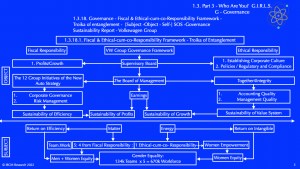
Corporate is a case of missing the forest for a tree. Recently big companies have laid off hundreds of employees. I keep wondering when we look at an organization’s FEC [Fiscal-Ethical-Co-responsibility] framework we see a company’s operating system only 6% of operations are measured leaving behind 94% unattended to. FEC Report is enabled by SOS [Subject – Object – Self] Governance Standards CorporateMOM provides you with. I have clearly mentioned in the FEC Framework – deploy women empowerment and man the 94% qualitative elements of management.
Secondly, realign your ERP projecting to 2030 all the elements of management, quantitative and qualitative elements of management on a CAGR – CDGR and CARR-CDRR system of tracking the operating system. 94% of the operating system needs as many men and women as demanded to complete the FEC Report. When 94% of jobs are to be carried out and without attending to it ASAP you are sacking the employees! Corporate handle only object governance. Corporate is of crazy guys picked from Gen X upwards looking for retirements.
Focusing on Gen Z Corporate shall discuss with the universities how they can teach the students to graduate in societal challenges the graduates can fit in easily to companies. In reality, Gen Z is the reverse mentor for companies stuck with the Ego System.
Illustratively take a look at Initiative Climate Bonds Certification – CLIMATE BONDS STANDARD: Globally recognised, Paris-aligned Certification of Debt Instruments, Entities, and Assets using robust, science-based methodologies Updated April 2023 Version 4.0. It states: Entities that have ambitious Climate Mitigation Performance Targets that are aligned with the Climate Bonds Sector Criteria at the time of Certification, or that will align by 2030, and that meet the requirements for Transition Plan and disclosure, as defined in this Standard.
And take a look at Sector Criteria that are currently eligible for Certification.
I also had a look at the speech delivered by Marshall Mermell, Circular Mining and Mine Remediation with Biochar who states: “Today’s, wastes will become the raw materials that abate climate change and damage and are financed through European Union climate bonds. Since March 2020, there have been over two plus trillion euros in climate bonds issued in this endeavor. Now, of course, other elements have interfered, like the war in Ukraine and other political events, but it’s still in process.”
When you look at the Climate Bond Certification Standard: “Launched in 2012, the Standard was initially designed as a mechanism to support confidence in the climate change action credentials of green bonds and other debt instruments and to provide a tool to allow quick investment decision making. Climate Bonds have Certified over USD270bn of Use of Proceeds Green Bonds since the launch of the Certification Scheme.” So USD270bn has been certified and two plus trillion euros climate bonds are issued and waiting to be certified. “Climate Mitigation Performance Targets that are aligned with the Climate Bonds Sector Criteria at the time of Certification, or that will align by 2030” is a long shot in the transition to a green economy.
Important points to be noted are 1. Climate Bond Certification is Object-oriented – certification of the environmental credentials of specific projects, assets, or activities, following the Climate Bonds sector-specific criteria. Sector Criteria that are currently eligible for Certification is again a long list. 2. Subject Governance is what men and women within an organization conduct themselves relative to the tasks assigned. In case of the VW case study from my book, it elaborates on 5 priorities as set by Matthias Müller:
Priority #1: Customer Satisfaction Priority #2: Uncover the truth and learn from it Priority #3: Change in Organization Structure: Priority #4: Establishing Corporate Culture Priority #5: Strategy 2025.
This I have elaborated why it is essential for every company to arrive at the frameworl FEC Framework. Considering the long period of the Transition to a Green Economy, 2030 for corporate, 2040 for critical metals, some countries 2050, 2060, 2070 what is needed is to establish SOS Governance in each and every company and FEC Report must be mandatory. Again and again I reiterate the VW case study is a must for business schools for Gen Z to learn, for between the cup and the lip how 11 million vehicles escaped diesel emission standards by implanting a cheat software.
Let me also quote from my book: “Corrado and Hulten (2010) estimate that in 2007, by omitting investments in intangibles, $4.1 trillion was excluded from published national accounts data in the U.S.”
1. Intangible Asset IAS 38 be scrapped and 2. establish FEC Report as a mandatory instrument by each company proactively.
The quality of a substance cannot be separated from it(the substance), nor the work associated with it. Intangible Asset is not a subtance of quality. FEC Report is the measure of work associated with a subtance of quality.
If Universities and Corporate come together to teach Gen Z who can be the reverse mentor for Gen X to Silent Generation categories, then, only then we can think of RGE – Revitalizing Global Economy, aligning to the Eco System.
Management is simple and Mission Operation COURAGE is possible.
CorporateMOM decodes Indian Statistical Ego-system Establishing a Dynamic GDP – GNH Database Systems
#CorporateMoM, #NSS, #ISI, #Statistics
CorporateMOM decodes Indian Statistical Ego-system Establishing a Dynamic GDP – GNH Database Systems
In response to “Ministry of Statistics and Programme Implementation: Critics from inside and outside” Bibek Debroy, states, “Supporters and critics agree on the urgent need for reform in India’s statistical system. It’s time for The Ministry of Statistics and Programme Implementation [MOSPI] to address concerns with the statistical system seriously. So we shall.”
This presentation CorporateMOM decodes Statistics Ego-system looks into it and the findings are:
[HACCP – Hazard Analysis and Critical Control Points of Stats Ego-System]
1. HACCP of Stats Ego-System 1: – “Fixing a major governance deficit” is the critical control point. 2. HACCP of Stats Ego-System 2: The road map should look into alternative means of data collection toward state and national GDP accumulators. 3. HACCP of Stats Ego-System 3: 1. We make policies in real-time, 2. RBI’s policy formulation is handicapped by frequent revisions to data. 4. HACCP of Stats Ego-System 4: 1. The sampling methodology of our surveys needs alternate options. 2. Governance is a dynamic function, facilitates policies in real-time. 5. HACCP of Stats Ego-System 5: 1. Misreporting the figures happens when there is no data stability. 2. Ministries have no standards to set targets and reach them methodically. 3. Mahalanobis Stats Ego-System had prevailed too long and the damage it has done to planning is immeasurable.
I have addressed these issues and offer a road map to establish a Dynamic GDP – GNH Database Systems. I recommend the current India’s Statistical System be scrapped.
I present here: CorporateMOM decodes M&A Ego-System. Corporate uses the word ecosystem so liberally. They should. The Ecosystem refers to Nature, whereas Ego-System refers to the individuals, and how they run their companies.
In this context, I have chosen $48.1 trillion pension funds assets to set target returns and align the Corporate Ego-System of Investee companies with the Ecosystem, so as to bring sustainability of profits and growths for the funds. In the 2023 study by OECD, Pension Funds stand at $48.1 Trillion as of the end of 2022 which is 15.6% less than the 2021 figures.
What the major funds have to necessarily focus is on the investee companies at the lowest rung of the fund users. I have as an illustration taken up M&A Ego-System. Assuming $ 48.1 Trillion Funds are used by 100k investee companies the top Funding Agency has to measure, the 100k fund users. The Ego-System of every company within 100k has to be measured and brought under SOS [Subject-Object-Self] Governance monitor.
The reason is simple, Invest and make sure you get returns. Although it is the dictum for corporate as a whole, Pension Funds, Sovereign Funds, or PF Funds have a greater responsibility toward making sure the investee companies have the governance standards set and followed. The reality check is abysmal. For example, the Life Insurance Corporation of India (LIC) has 273 listed stocks in its portfolio worth INR 10tn ($133bn). LIC takes a Board position in several companies as they did with IL&FS. The reality check is indeed abysmal. So the Corporate Ego-System prevailing today is abysmal. Pension Funds must check their own premises. To quote from the 2020 OECD Report:
Q: Pension funds invested mainly in equities and bonds Pension funds were mostly invested in equities and bonds at the end of 2019. Pension funds held more than 75% of their portfolios in equities and bonds in 16 out of 36 reporting OECD countries and in 17 out of 28 other reporting jurisdictions. Pension funds invested in these instruments directly or indirectly through collective investment schemes (CIS). UQ
I am comparing the Corporate Ego-System today similar to what it was in 1616 when Galileo was imprisoned for correcting the Ego-System prevalent during that time that was pretty topsy-turvy. However, Galileo resolved the subject of the then Ego-System by means of science. Changing the mindsets of people needs scientific evidence.
CorporateMOM approaches the subject in the same manner. Aligning the Corporate Ego-System with the Ecosystem needs scientific reasoning when we argue and derive conclusions from observed data. What is lacking from the investee companies is the critical FEC [Fiscal-Ethical-Co-Responsibility] Report that CorporateMOM recommends. CorporateMOM is what Galileo would have been proud of – the science of Law of Physics, Quantum Physics, and Metaphysics are applied to Corporate Management.
Investee companies of their own are not going to adhere to value systems AFTER the funding is done. So CorporateMOM establishes a MeRIT System where it helps investee companies to create a standard Strategy Plan and by MeRIT – Measure, Record, Implement and Track the operations on a daily basis by converting CAGR to CDGR. The Creative Process of the Strategy Plan is crucial for Action Process. The six stages of Transformation by Investee companies from a Dream state to creating a Substance of Quality called an IPR or Policy Documents or Strategy Plan help investee companies to approach VCs with a robust Plan of Action. Once approved and the funds are made available Investee companies can activate the Action Plan instantly. As described in CAGR to CDGR, CARR to CDRR [Reduction Rate] a daily growth of investee companies would facilitate the investors to track the progress.
Looking at OECD stats I find the collection of data mentioned in their 2023 report as preliminary. What CorporateMOM suggests for investee companies to establish CDGR and CDRR would trigger stats on the go. Meaning governance is dynamic and OECD should look into developing stats on a daily basis.
CorporateMOM – Mission Possible – Mandatory Corporate FEC – [Fiscal-Ethical-Co-Responsibility] Report – My Services
After my post on LinkedIn CorporateMOM and Fund Management wherein I expressed my MISSION POSSIBLE to approach GoI to make FEC (Fiscal-Ethical-co-Responsibilty) Report mandatory, I got a good response and positive thumbs up. I have prepared a video talk as below. Please take a look. Here I am adding to indicate what my charges are, for services that I offer, as inquired by one of my LinkedIn connections.
My Services:
Consequent to my recent posts Mr. Venkatesh Muniyellappa [ linkedin.com/in/venkateshmuniyellappa ] called me over the phone and we had a chat about what services I offer and what would be the charges.
In my CorporateMOM Mission Possible, I made clear what I offer.
1. On a Corporate Level – I shall help companies to establish:
i. As a first step change your organization structure.
ii. Prepare an FEC Report.
Venkatesh was asking what the charges for my services. My response to him was:
1. With CorporateMOM available in book form, a one-day introduction would prepare the managers for DIY. I am keen for many companies to come forward. FEC Report ultimately going to put such companies on a high pedestal of growth. For companies that decide to go in for CorporateMOM principles a monthly retainership would do.
2. For companies like Opal Advisors where Venkatesh is in the driver’s seat as I have indicated in CorporateMOM and Fund Management, the three-tier Investor-Investee relationship be strengthened with an FEC Report. I have given the Volkswagen FEC Framework Report – companies shall prepare similar Reports in their own names. Due diligence of the investee company I shall assist, in preparing the Strategy Plan 2030 by MeRIT – Measure, Record, Implement, and Track. It is the investee company’s responsibility to convince the investors as to how an FEC Report of the investee company assures performance to the investors. It is on a continuous basis.
3. I will also assist companies like OPAL Advisors to prepare an FEC Report so that companies they invest in or do consulting or obtain funds for their own expansion are duly reported. I recommend companies take two articles out of UNCAC – Article 10 Public Reporting and Article 13 – Participation of Society. Article 13 emphasizes the commitment of a company toward society and Article 10 Reporting to the public what the FEC report is looking at in terms of justifying the actions of men and women who have been handling the affairs of the company.
What are my charges? Nothing much. You can write to me if you are interested in preparing an FEC Report for your company, and I shall guide you. If we all can break the current ecosystem that would be good – don’t get stuck with big names MNCs.
4. Universities: Guide the corporate, not the other way round. You are churning out the same MBAs for over 50 years. Should the companies come for placement interviews present your graduates with their in-depth knowledge of CorporateMOM and ready to implement FEC Framework in their companies.
NOTE: IBCM Technology shall assist companies to prepare an FEC Report and establish the CREAM Rating System and would certify it. CREAM is an acronym for Corporate Governance, Risk Management, Earnings, Accounting Quality and Management Quality.
Thanks a lot for your initiative. I am indeed grateful. #AI is important and let us see how this could be well made use of. I collected some info. I have installed Bing: Chat with AI & GPT-4, so I have world library access. I have some genius around me that I can surely check on.
Automation, chatbots, adaptive intelligence, algorithm trading, and ML are all used in financial activities. Several banks already use AI-based systems or software to provide customer service and identify abnormalities and fraud. AI is significantly valuable for the banking industry when it comes to fraud detection.
3. What are the 4 types of AI?
4 main types of artificial intelligence * Reactive machines. Reactive machines are AI systems that have no memory and are task specific, meaning that an input always delivers the same output. … * Limited memory. The next type of AI in its evolution is limited memory. … * Theory of mind. … * Self-awareness. Unquote
1. Artificial Intelligence Examples
One of the missing items is Agriculture. Others can be added – Forestry, Circular Mining, Food Industry. Project FISCAL I had already published consists of FARMER- INDUSTRY – SOCIETY & CONSOLIDATE – AGRI – LEADERSHIP. This is very important for all third-world countries, What #AI can do?
To pick a few:
a. Manufacturing Robots – Product Engineering – Digital Transformation for big industrial units – Steel or Nuclear. b. Healthcare management. Huge no doubt.
2. Major emphasis: Several banks already use AI-based systems or software to provide customer service and identify abnormalities and fraud.
3. 4 main types of artificial intelligence
a. Currently we are in the 1 st stage – reactive machines. Triggered by humans.
b. Limited Memory – Most difficult stage – giving a limited memory of its own. Is a wake-up alarm type but whether it would snooze or not is of its own, is the HACCP- Hazard Analysis and Critical Control Points of AI.
c. Theory of mind. …
When an individual goes to a psychiatrist it is one-to-one. Non-disclosures of the patient happen all the time. The doctor prescribes some medicines and closes the issue. But patient issues go on forever. America, America!
We are dealing with corporate minds. A company like VW has 870k people. In the example given above, Healthcare super-specialty hospitals run on a quota basis – that is, doctors have a quota to fulfill. If one doctor finds nothing when we go for a check-up he will not certify us ok, but would find something not OK to another doctor. By the time we come out of the next who would ask us to go for a CAT Scan? His interpretation is the ultimate. Prescribed drugs rule the roost remotely controlled by Pharma companies.
Secondly “Several banks already use AI-based systems or software to provide customer service and identify abnormalities and fraud.” Identify abnormalities and fraud are going on for decades without any results. Silicon Valley Bank has gone down the drain. Credit Suisse and First Republic are closed but a window opened by UBS and JP Morgan. Recovery rates are abysmal.
The third stage is Theory of Mind.. we are looking at mass psychology not one-to-one. That’s where CorporateMOM has come into the picture. The book CorporateMOM with a case study on VW provides with a Framework for FEC – Fiscal, Ethical-cum-co-responsibility Factors, covering 870k people. How is it delivered by the 4th Stage, see next.
d. Self-awareness. CorporateMOM defines Leadership as – Self-Awareness, Self-Control, and Self-Governance. Please see page 107 of CorporateMOM.
Please see p196 FEC report on Credit Suisse.
CorporateMOM is the ultimate utilizer of AI integrating the good of everything.
If anyone is interested in an AI Research Report from my side I am willing to take it up and provide a report for decision-making. I have access to many things including some good brains on #AI. Consulting assignment can be accomplished and please let me know what I would get in terms consulting fee. I am willing.
I suggest those who are involved please buy the book: CorporateMOM
eBook may be quicker for kickstart. We can resolve many an issue.
Your company may have any number of business segments. Prepare an FEC Report for each one. See Page 196 and prepare an AI Business Segment FEC Report, only for FEC.
This is a review of my book CorporateMOM Sustainability of Corporate Stability. I just received my copies. Going through it I shall give a brief view of how it has come out.
I used Mac Keynote for preparing this self-published book – CorporateMOM. It’s patterned on Gurucharan Das’s one-page report concept. I used 14pt Optima with Subtitles on every page. Content has to be compressed into a few words. There are 225 pages, interspersed with images and illustrations so the readers have a smooth and quick reading, Physics, metaphysics, and quantum physics are applied to deriving a robust management operating control system. Understanding the concepts is made pretty simple with charts supplemented by QR Codes that take you to a dynamic reading. You will never be bored like text after text with Times Roman 10pt.
After my first book, Corporate Citizenship and Sustainability: Measuring Intangible, Fiscal and Ethical Assets, I have learned this lesson to make a book interesting. My first book is purely theory – Physics, metaphysics, and quantum physics. I carried on with Podcast Episodes, 35 of them – dealing with a number of very critical areas in the practice of management.- Accounting Quality Audit firms, Accounting for Climate Change; Analytics of Scope 1, Scope 2, and Scope 3 parameters; IMF Transition to Green Economy – IMF World Economic Outlook Data Analytics., Suggestions on Draft National Policy to the Ministry of MSMEs, Corporate Governance Toolkit, etc. 35 of them that have attracted nearly 300k downloads. I have given them QR Codes that readers can go to any one of them. I have given also the number of countries viewers of podcasts as well as companies who have viewed my posts. Please have a look.
2. Ecosystem on the move. For the first time in history, certain positive signs are coming for a change. One is the opening of the New Parliament by Prime Minister Modi last week. He encouraged all to comment on a silent video adding one’s own. I did. Sengol was installed in the Parliament that I said: Q: Sengol – scepter not to rule but to justify our conduct. Let the New parliament usher in how men and women conduct themselves, not only reporting Fiscal but their conduct Ethical-cum-co-responsibility factors, making it mandatory for Corporate and Government Institutions. UQ
This is what CorporateMOM teaches – SOS Governance – Subject – Object – Self Governance Framework. Corporate is yet in the shadows of East India Company. Third-world countries are realizing it all. To quote Desmond Tutu: “We closed our eyes. When we opened them we had the Bible and they had the land.” Companies that follow SOS Governance principles are going to attract more business than many MNCs. I have included a case study on Volkswagen that is important for all companies to prepare an FEC Report – Fiscal, Ethical-cum-co-repsonsibility report.
3. Universities: Universities are in education. But today a seat in a good college demands a very high price for their parents, at least in India. Investment in a Business School must reflect on the graduates coming out with knowledge. The knowledge of how men and women in corporate conduct themselves. Since many companies including IBM, Apple, EY, and Wipro Foundation have evinced interest in CorporaeMOM, Business Schools would attract big companies at the campus placement. Wipro Foundation takes care of many schools and should popularize CorporateMOM at the school level. Management science is not complicated. Bring it up from the school level.
4. Regulatory Body installed in the Parliament – Sengol: What if the New parliament enacts a mandatory report filing of conduct in Ethical-cum-co-responsibility factors? In fact, it already exists under SEBI guidelines. CorporateMOM would help companies to stabilize and report on how the qualitative elements of management are measured. Are you ready?
CERN states, (a) subatomic matter not only performs an energy dance but also is an energy dance and (b) subatomic matter does not remain static. We shall restrict subatomic matter to protons, neutrons, and electrons for this work, which primarily establishes the connection between corporate and nature.
Corporate must innovate to be vibrant all the time, as Energy is liberated matter; matter is energy, waiting to happen. Waiting to happen is static a nd leads to NPAs. This book I have prepared with dynamic study of texts and illustrations, not static ones. For example, a Corporate Atomic Structure illustration is nothing but what you see as a static picture in your book. I have provided a QR Code that leads you to a 1-minute video on how CorporateMOM works providing a conceptual understanding of the subject matter. Similarly links to Bloomberg GEI page. Readers can have further confirmation or study on the subject with QR Codes by facilitating the reading of the Book: CorporateMOM.
Pictures convey supporting the context that readers would find easy. The book is not verbose text after text. Besides I have followed our management guru Gurucharandas in his 1-page report. Managers are busy bees, so I have structured the entire book by the 1-page report principle, completing the argument within a single page. There are 222 pages but each is unique.
Hardbound book I am releasing today. The soft Cover and eBook are released later today. My publishers say Hardbound book is made available only within India. I am happy with the publishers as it is cost plus + Royalty. I don’t see ny price difference between the Hard and soft covers except for a few rupees. Here is the link.
Podcast Episode 34: Snapshot 6: Book in the process: Fiscal and Ethical Assets – the stability factor – CorporateMOM – Sustainability of Corporate Stability
I am adding a couple of pages of how I am readying for the publication of my book before the end of April 2023.
A spontaneous urge to action rather than inaction’ Volkswagen Group – Change of guard – 2022. While I am presenting what Matthias Müller set the priorities vis-à-vis what Herbert Diess has done on the paradigm shift based on Annual Report 2021, I find from Annual Report 2022 a further change. Quote: The Supervisory Board meeting on July 22, 2022, focused on the composition of the Board of Management of Volkswagen AG. We resolved at this meeting to appoint Dr. Oliver Blume as the Chair of the Board of Management of Volkswagen AG effective September 1, 2022 and agreed with Dr. Herbert Diess that he would step down from this position at the same time. Unquote.
1. Fiscal Responsibility – What You owe your company. You create the Fiscal assets for your company. Stays with the company forever. Priority #1: Customer Satisfaction, #3 Change in Organization Structure: and #5 Strategy 2025 deals with this.
2. Ethical Responsibility – What You owe yourself – You create ethical assets for your company that stay with you forever. What you create for one company you can carry to another. Priority #4 Establishing Corporate Culture would represent this.
3. Co-Responsibility – What You owe the society – an identity with ethical responsibility, that by which corporate infers and society teaches. Priority #2: “Uncover the truth and learn from it” would fit into this. Unquote
I sincerely hope Dr. Oliver Blume continues with the T4I Together for Integrity that Dr. Diess has initiated. I will do the follow-up analytics later. This book which is under preparation is critical for corporate stability. Sustainability of Stability is what we are looking at, through the prism of Women’s Empowerment.
Dr. Herbert Dies’s initiative is what every company must look to. His contribution to the corporate world is quite great, really great. I am sure Dr. Diess’ capability is used by other companies and groups. Piech and Porche will all come and stay and not leave their fiscal assets whereas Dr. types take their ethical assets wherever they move. The 21st century is on the move. Attrition of value is for Dr. Oliver Blume to take note of.
Big firms must take note of it what Keynes says: “Even apart from the instability due to speculation, there is the instability due to the characteristic of human nature.” SOS Governance will set right the current ecosystem.
CorporateMOM turns April Fool’s Day to Goal Congruence Day
April Fool’s Day * •April Fools’ Day or All Fools’ Day is an annual custom on 1 April consisting of practical jokes and hoaxes. * •Is an important day for Corporate India and the Government of India. On this day New Fiscal Year starts, and the old one comes to a close.
Closing the books – Beating Retreat ceremony * It is a frantic day. Scope 1 parameters spoil the broth. Upstream companies could not hold their fixed costs. * It is matched with our own fixed costs that had gone awry, despite frantic efforts in the last month. * Every company on this all Fools’ Day plays the game of passing the buck.
Profits, profits, profits * The CFO team is the most important on April 1st. Drums and bugles herald the New Fiscal Year. ERP is ready. Let us look to the future, not the one that had gone away. We can’t do anything now. * Journal entries after journal entries are passed. Profits, profits, and profits do not match the expectation. Worried faces wonder what would happen in the stock market, when would the bankers start crawling back to our office. Ha foolish to be an accountant, sighs the CFO on this eventful All fools’ day.
Emergency kitchen cabinet meet * CEO, the retinue of VPs, and the CFO call for an emergency meeting of the kitchen cabinet. Adverse variances analytics make each VP jump and accusing the other responsible for the All Fools’ Day. * CEO dismisses all but one. * Can we do something? Our reputation is at stake. * CFO returns and journal after journal entries passed are reversed. CEO comes to CFO’s office. A new recipe is put forward. CEO nods ok. The cooking is complete. Reputation restored.
Reality Check Flat Organization Structure
* My book extract: * For decades, the structure has remained the same. The platform is a unidimensional organization that runs from procurement to manufacturing to sales and every other structure. It comprises the board of directors, CEO, and vice presidents. All form part of a flat organization, with all the eggs in a single basket. The results are completely anarchic. Where every individual is different, each is different in different places. In any organization, you see how each individual is governed by their own idiosyncrasies. There is no corporate goal congruence. What is comprehensible in an organization is how incomprehensible it is. Corporate must shake themselves free from the “earth is as flat as a trencher” outlook.
My experience Forestry Operations * My book extract:
Working on wood accounting while I was a forestry operations accountant of WIMCO (a subsidiary of Swedish Match Company) in Mysore, in the south of India, also served as an interesting perspective. The Mysore branch supplied wood to two WIMCO factories—one in Ambernath (near Mumbai) and another at Chennai (in Tamil Nadu).
* My book extract: The accounting year for WIMCO was January to December whereas forestry operations took place between September and April, on the basis of the monsoon. So, at the beginning of an accounting year in January, factory costing would have to take note of wood felling from one season of the current season (September previous year to April current year) and 4 months from the next season (September to December current year, as part of next season September current year to April next year), which is unpredictable. It is unpredictable, as the foresters mark the trees for felling for the next season and start their work in the following September.
* My book extract: I introduced a cost accounting method called the likely ultimate cost (LUC) for the factories to get a uniform cost throughout the year so that their monthly profitability statements would not fluctuate from month to month. LUC is the cost figure related to the end of the accounting year charges for the wood supplied but a standard cost from the beginning of the year. This LUC helped me in projecting a figure for the future and bringing it to today’s level in the form of compound annual growth rate (CAGR) and compound annual reduction rate (CARR) converted into CDGR and CDRR (D-Daily), which you see in CorporateMOM.
CorporateMOM adopts CAGR and CDGR When we discuss Scope 1 parameters to be met it extends to 2030, 2040, 2060, and 2070 targets to be met. CorporateMOM converts CAGR to CDGR or CARR [Reduction Rate] to CDRR. That’s Daily. Keeps track of every component that makes up the targets.
CorporateMOM adopts CREAM Report Playing an ODI Cricket
In my case study of HUL P&L and Balance Sheets are analyzed from 2007. In one year when they switched to the April fool’s Day Fiscal Year the number of days for the fiscal year was 457. Revenue or consumption per day was analyzed for uniform day-to-day ratios. CREAM is an acronym for Corporate Governance, Risk management, Earnings, Accounting Quality, and Management Quality. Earnings are quantitative with 12 process blocks and the rest constitute 188 Process Blocks that are qualitative. When companies adopt CDGR it is like playing an ODI cricket.
My experience Shipping Construction
* My book extract:
I took up a consulting assignment for the Shipping Credit and Investment Company of India (SCICI) on cost accounting of shipping construction. SCICI was providing funds to shipowners at a low-interest rate (a third of the prevailing bank rates). There were three parties to it: the shipowner, the shipbuilder, and SCICI. Shipowners taking the funds from SCICI would divert them to other than shipbuilding in their group companies. SCICI asked me to bring out shipping construction stages so that it could release funds according to the stages completed. This called for a detailed shipping construction manual, literally.
* My book extract: While working on this, I found Japan’s influence on the scenario in shipbuilding most interesting. After World War II, an air force veteran in Japan was entrusted with the charge of shipbuilding. He went around the globe visiting various shipyards and found they were building in the same pattern as before, from laying the keel upward.
* My book extract: Being an air force man, he could not accept this practice and introduced the block development process of shipping construction. Different blocks constructed at the same time at different places and assembled at the shipyard reduced the time of construction substantially, from 16 years to 4 years. Placing an order 3 years in advance for items like the main engine, which would arrive in time for the requisite blocks, is an example of the kind of changes he effected.
CorporateMOM adopts process blocks technology * I adopted the shipping process block technology for the preparation of a CREAM— corporate governance, risk management, earnings, accounting quality, and management quality—Report.
In an organization, there are 200 open-ended process blocks. If there are 100k people in a company a 5-member team is formed of 20k teams. Each team is assigned specific tasks accomplishment – creative as well as action. Each member is yoked together but works independently.
CorporateMOM brings in Goal Congruence * Return on Intangible is the equation CorporateMOM provides. * Intangible is the effort and for each person the same capability that is 1 as the denominator. * Numerator is action or inaction brings a binary value for each person. * Each is a gold medalist. Silver and Bronze medalists strive to get gold in an organization, enabling the accomplishment of an infinite succession of finite purposes by controlling each goal. * That goal is the same for all, optimize capability, the Goal Congruence.
My Message Matter and Energy: The three laws CorporateMOM uses for Corporate Sustainability are: Law 1: Energy is liberated matter. We show under P&L and Balance Sheet. Law 2: Matter is energy waiting to happen. Raw materials to godown to finished goods stores to NPAs. Law 3: When anti-matter collides with matter it forms pure energy. That’s to say push Law 2 to Law 1. Each process block is dealt with under these three laws of the Universe.
Podcast Episode #31 CorporateMOM Calls the Banks for Spontaneous Urge to Action – Measure Cost Consequence Now, Now, Now. A Credit Suisse case study.
CorporateMOM Calls the Banks for Spontaneous Urge to Action – Measure Cost Consequence Now, Now, Now . A Credit Suisse case study.
CorporateMOM is a derivative of my IPR – IBCM – Inactivity-Based Cost Management: Activity has a Cost Incidence, whereas Inactivity a cost consequence. Measure Cost Consequence, Now, Now, Now.
Lessons we learn from Credit Suisse? 1. Unstable corporate architecture. 2. No Accountability: 3. No Governance
Let us explore how CorporateMOM looks at it.
CorporateMOM is already published with a Case Study on #Volkswagen. I shall present here an extract of the same that is relevant to the case study we are looking at – a case study on Credit Suisse, succinctly.
2. No Accountability: CorporateMOM deals comprehensively with Return on Intangibles.
3. No Governance CorporateMOM deals comprehensively with Subject – Object – Self-governance Framework.
I present here an extract from CorporateMOM – a Volkswagen Case Study.
Quote: 1.3.5. Governance – 1. Economic – Troika of entanglement – [Subject -Object – Self-] SOS -Governance 1.3.5.1. Volkswagen Case Study – a spontaneous urge to action rather than inaction’ On 28th October 2015 Matthias Müller, Chairman of the Board of Management announced the five key steps to realign the Group. They are stated as Priority #1 to #5. The webpage no longer exists. Matthias Müller was replaced in 2018 by Herbert Diess Chairman of the Management Board, CEO, and Chairman of the Volkswagen Brand Board of Management. For the sake of the sustainability of responsible policies, I am keen to go from what Matthias Müller had planned then and assess what Volkswagen Annual Report 2021 has come out with.
Priority #1: Customer Satisfaction Priority #2: “uncover the truth and learn from it” Priority #3: Change in Organization Structure: Priority #4: Establishing Corporate Culture Priority #5: Strategy 2025
We will take the stock of the situation in VW Group based on what Matthias Müller had intended to do with this set of 5 Priorities. Unquote:
VW and Credit Suisse Case studies compared:
Priority #1: Customer Satisfaction
CorporateMOM case study on #Volkswagen 2021 is an eye-opener. VW has done well in scoring well on Priority #1.
But it has taken 6 years. Credit Suisse shall note that customer satisfaction takes time but the process must start now, now, now. Policy making, Policy Accidents, and Policy Politics need to clearly made and tracked.
That depends on focusing on Priority #2 to Priority #5.
Priority #2: “uncover the truth and learn from it”
My study on #Volkswagen reveals a big thumbs down.
Credit Suisse is in a better position because the top brass has come under a different top brass – UBS. Whereas #Volkswagen has to continue the journey with the unchanged Supervisory Board. The job undertaken by Dr. Herbert Diess who changed VW is quite remarkable, given the circumstances under which he had to function.
For Ralph Hamers Group CEO of UBS Group AG, Credit Suisse is nothing but a plug-and-play USB for UBS. Priority #2 when done well would get a thumbs-up sign from CorporateMOM.
Priority #3: Change in Organization Structure:
My Comment on #Volkswagen: Priority #3: Change in Organization Structure: – This is the crucial aspect of a company to bring abstractions into reality. Governance must be managed. When there is attrition of values how do we control the gradual decline of morality? Changes in organizational structure must reflect in the corporate value system.
For Credit Suisse: hierarchical one-man call center be scrapped. Establish Corporate Atomic Structure in the same pattern as the Universe. 1. It assists individuals to accomplish tasks in an infinite succession of finite purposes., by controlling each goal. 2. It provides you with everlasting benchmarks and metrics, aiding your strategy Planning Process. 3. Delineation of responsibilities between the troika of entanglement – The Board, The CEO Team, and the Society. 4. Matter and Energy well calibrated.
Priority #4: Establishing Corporate Culture
A culture is a function of true knowledge of awareness, an identity with ethical responsibility, that by which corporate infers and society teaches.
From Volkswagen Analytics:
1.3.11.4: Code of Collaboration and Together4Integrity
The Code of Collaboration, along with our integrity and compliance program Together4Integrity (T41), is a central pillar of the new Group strategy NEW AUTO. This Code describes how collaboration is to take place within the Group and between individuals in their day-to-day work. Its core values are encapsulated in the terms “genuine”, “straightforward”, “open-minded”, “as equals” and “united”. T41 brings together all activities relating to integrity, culture, compliance, risk management, and human resources, creating • common path toward a new corporate culture. Unquote
Good initiative by Volkswagen. Credit Suisse shall adopt similar initiatives.
Return on Intangible.
For Credit Suisse: Priority #4: Establishing Corporate Culture: Return on Intangible. : CorporteMOM provides you with Return on Intangible. Is an Equation: Numerator – Action or Inaction: Denominator – Intangible – Effort by one person. The denominator is common to all, each and every person of your workforce. That is Intangible bears a value of 1, equal capability.. The equation gets a binary value of 1 or 0 based on Action or Inaction. Performance or contribution by each person is Measured.
Priority #5: Strategy 2025
From Volkswagen Analytics:
Quote: As the new Group strategy NEW AUTO is currently being concretized and enhanced, the content of the KPIs and the correspondingly adjusted targets for 2030 in the target dimensions are still being determined. As part of this, the relevance of the KPIs will be reviewed at the Group level and their focus will be continuously monitored and adjusted as necessary. Unquote.
My comment: Strategy 2030 is the next stage. For a company like VW group Scope 1, Scope 2 and Scope 3 parameters are crucial for undertaking the fiscal responsibility to its natural growth and expansion. At this juncture, VW Group has taken it forward impeccably.
The next stage is the Action process how the efforts are greater. Efforts are of the people. This calls for a different denominator than the Return on Investment. So Return on Intangible is the solution.
For Credit Suisse: Priority #5: Strategy 2025: CorporateMOM – Strategy blueprint in 6 Stages of the strategy planning process – 0. Dream, 1. strategy idea, 2. strategy communication, 3. strategy formation, 4. strategy formulation, and then 5. the strategy plan, comprising of the creative process as to how the Strategy Plan Credit Suisse – Transformation, is created.
Then to 6. our efforts greater is the action process. Get ready for Strategy Plan 2025 on a priority basis, by CorporateMOM MeRIT – Measure, Record, Implement, and Track.
Over to [Subject -Object – Self-] SOS -Governance Framework – for UBS – Credit Suisse.
Governance – Fiscal & Ethical-cum-co-Responsibility Framework – Troika of entanglement – [Subject -Object – Self-] SOS -Governance Sustainability Report – UBS Group AG – Credit Suisse
Summary:
Two groups: Fiscal and Ethical-cum-Co-responsibility Under Fiscal Responsibility:
1. Priority #2: “uncover the truth and learn from it” 2. Priority #4 Establishing Corporate Culture
We prepare a CREAM Report:
CREAM is an acronym for Corporate Governance, Risk Management, Earnings, Accounting Quality, and Management Quality.
If you look at the chart, Corporate Governance, and Risk Management comes under Fiscal Responsibility. Accounting Quality and Management Quality come under Ethical-cum-Co-responsibility. The net result of it is E which is Earnings.
When you look at the Corporate Governance aspects you are looking at several risk factors, as The OCC has defined nine categories of risk for bank supervision purposes. These risks are Credit, Interest Rate, Liquidity, Price, Foreign Exchange, Transaction, Compliance, Strategic, and Reputation.
Barring Reputation the eight would be under Fiscal Responsibility. The Reputation aspect of it would come under Ethical-cum-co-responsibility.
Looking at the chart you will notice Sustainability of Efficiency gives you profits whereas Sustainability of Value System alone gives Sustainability of Profits & Growth. It’s important.
Return on Efficiency and Return on Intangible
Return on Efficiency looks at the Object that’s Matter. Create Team Work. 4 from Fiscal Responsibility and 1 from Ethical-cum-co-responsibility.
You have Men + Women Equity created from Return on Efficiency and from Return on Intangible Ethical-cum-co-responsibility factors are accounted for.
Here I have given Ethical-cum-co-responsibility entire responsibility is given to women’s Empowerment, from where you get Women’s Equity. Women also work under Fiscal Responsibility where you get Men + Women Equity. Women’s Equity is on both sides Fiscal Responsibility and Ethical-cum-co-responsibility because Women have contributed or not participated in all these Boys only Club problems. Women hold the dual-responsibility.
If you look at Credit Suisse itself as well as you will find there is no mention of SVB and any of those banks that have gone bust, I have not seen any woman being indicated as being responsible for [the bust].
This is very important. We have about 200 Quantitative and Qualitative Elements of Management, Quantitative about 12 elements we show under Earnings. Qualitative we don’t show at all. The entire 188 Qualitative Elements warrant Women to take over Ethical-cum-co-responsibility factors.
That’s what CorporateMOM pulls in then you can easily find out in the Credit Suisse example. These are 10k teams as Credit Suisse has a 50k workforce with each team made up of 5 members. That each and every member from the janitor to the CEO and the Board knows what the work requirements are or what effort they put in to reorganize and completely change Credit Suisse to what it is today to what you would like to be as per Strategy Plan 2025 or 2030.
This you can measure by Return on Intangible, if you have 2025 CAGR put that as on today converting to CDGR – a Daily report – CREAM Report – of how things are moving further to reach the target. CAGR to CDGR of profits and growth targets.
That’s about it. I would very much appreciate Gender Equality being maintained, particularly in this Credit Suisse Framework – SOS Governance Framework.
My Message
CorporateMOM Calls the Banks for Spontaneous Urge to Action – Measure Cost Consequence Now, Now, Now A Credit Suisse case study –
Keynes’s Animal Spirits call for a spontaneous urge to action rather than inaction. The 50k workforce of Credit Suisse are the only people who can trigger their urge to act upon the 5 priorities SOS Framework has brought in. CorporateMOM downloadable files have all the building blocks necessary to construct value and deconstruct valueless of Credit Suisse.
Podcast Episode #30 CorporateMOM – Sustainability of Corporate Stability
CorporateMOM is Corporate Management Orbiter Mission. Corporate is the central pillar of the global economy but collectively the current eco-system has made it unstable. Make it stable. The mission is to make sure the Sustainability of Corporate Stability is ensured. That’s the purpose. There’s no different opinion among any as to stabilize the corporate management. The key word is sustainability, which is sustained corporate stability.
Lessons we learn from SVB?
Lessons we learn from SVB?
1. Unstable corporate architecture.
CorporateMOM deals comprehensively with Corporate Atomic Structure.
2. No Accountability:
CorporateMOM deals comprehensively with Return on Intangible.
3. No Governance
CorporateMOM deals comprehensively with Subject – Object – Self-governance Framework.
[Amazing isn’t it? Same issues as they were from Industrial Revolution – i 1.0, i2.0, i 3.0 and going on in i 4.0?]
Podcast Episode #21 SDG Goal#5 – Women Empowerment – Series 2 – CorporateMOM
CorporateMOM is Corporate Management Orbiter Mission. In series #2 I shall touch upon the role that shall be played by Women Empowerment. The case study undertaken is Volkswagen. I am giving the Volkswagen Fiscal-Ethical-cum-co-resposnsibility Framework.
There are 170 open-ended process blocks, a Subject-Object distinction of Qualitative -Quantitative Elements of Management that every company has. Quantitative is just about 12 that we show in the Balance Sheet and P&L whereas 158 qualitative elements such as code of good conduct or code of business principles or corporate culture we do not measure but ignore.
Volkswagen’s study of creating a framework that I am giving in this series #2, is critical for companies to progress. The classic case is Twitter. Herbert Diess has recognized and brought about the needed changes in establishing a value system within. @elonmusk should look into it. Not that Twitter is unique as every company must have a study of what Volkswagen has initiated and how CREAM Technology assists companies to grow.
Women’s Empowerment is important and that’s why CREAM Technology has come out with this Basic Course. Elon Musk shall follow Herbert Diess and Volkswagen is not a competitor by any stretch of the imagination. Investment in Twitter cannot be by RoI Return on Investment but by RoI Return on Intangible that CREAM Technology facilitates. Here I am with Series 2 – CorporateMOM how Women Empowerment brings stability to an organization through their Corporate Management Orbiter Mission.
My Message:
To err is human and to correct it is superhuman. That’s what Herbert Diess is. Germany after World War II had Konrad Adenauer reconstructing the nation from ruins. One is economic ruin and another is corruption as Kofi Annan says, an insidious plaque that has a wide range of corrosive effects on societies. PM Modi and Herbert Diess are of superior kinds in bringing value systems within their domains.
It can be accomplished not by catchwords but by Women’s Empowerment. CorporateMOM is an absolute necessity for constructing values in any company. I find Women’s Equity central to the 17 SDGs. Ensuring its success in each of the 17 SDGs is going to trigger a tectonic shift in the three spheres of influence – political, economic, and public life.
As I said in Lesson 1, we are living on a DIY Planet. Philosophers, Scientists, Economists, and Consultants are just advisories. As said in Strategy Plan Process, “Our Commitment Deeper and And Our Efforts Greater” ushering in Women Empowerment that truly would take corporate to greater heights.
Women Empowerment as a policy document must emanate from corporate whereas Women Equity is a MeRIT Tracker for Women that CREAM Technology offers in measuring, recording, implementing, and tracking women equity by each person. That’s all.
Podcast Episode #21 SDG Goal#5 – Women Empowerment – Series 2 – CorporateMOM
Podcast Episode #20 SDG Goal#5 – Women Empowerment – Series 1 – DIY
Podcast Episode #20 SDG Goal#5 – Women Empowerment – Series 1 – DI
In a series of short videos, I shall bring you the essence of Women’s Empowerment, an extract from what I have published on my site https://ibcm.in/homepage/ CorporateMOM
The Basic course is indeed overarching. Keynes’ Troika of Entanglement Moral, Hedonistic, and Economic aspects. Philosophers, Scientists, Economists as well as consultants as advisories. It deals with a case study on Volkswagen overarching again with SOS [Subject-Object-Self] Governance standards brought in. All roads lead to Rome as the saying goes for SDG Goal#5 Gender Equality which is Women’s Empowerment. With these short videos, I shall bring to you the purpose – Women Empowerment – the first of a series SDG Goal#5 – Women Empowerment – Series 1 – DIY
Snapshot from CorporateMOM – for full details downloadable files are made available at my site: https://ibcm.in/homepage/
This is from CorporateMOM – ref.: 1.3. Part 3 – Who Are You? G.I.R.L.S.: S – Strategy
Quote: Ladies and Girls,
Women’s Empowerment: Please note Women’s Empowerment – ask yourself who is to empower whom?
Women’s suffrage: 1. In the US: For women the right to vote, a right known as women’s suffrage, was ratified on August 18, 1920, ending almost a century of protest. 2. In the UK on the 10th of January 1918 the House of Lords gave approval for women over the age of thirty who met a property qualification to vote.
After women’s suffrage came into play what happened next? Nothing absolutely nothing. Women Suffrage once obtained what did the women get? Nothing. That’s because they didn’t have the plan to start with and thereby no plan of action to follow. Unquote. {My Podcast Episode #17]
That’s what this Lesson #1 brings to Women Equity, a plan of action to bring about a complete change in the principles of women’s empowerment. The Boys only Club is going to be the most benefited, for having CorporateMOM orbiting the Corporate Nucleus with the CEO Team.
Diversity:
Race, Nationality, Age, Ethnicity, culture, etc., etc., for women that we know of? This would exasperate women to no end. Take the example of a flight stewardess or accounts executive. Having been entrusted with the co-responsibility factors for overseeing value systems within a company why should we get into the Diversity factor? Women have to think in terms of unity in diversity not accentuate differences between them. Take note.
Equity: Women or Men Equity is the effort each person puts in and her/ his personal earnings out of their own performance. Ethical Assets are earned. It belongs to the individual and not to the company.
Inclusion:
Empowering women with the dual responsibility for creating fiscal and ethical assets would have a tectonic shift in corporate development and growth. The wise Board of Directors shall take note of it.
Code of collaboration and Together4Integrity are excellent policy documents that would energize companies around the world. Not only in VW but in any company when they adopt.
For implementing Sustainability of Value Systems women are naturally born with. CorporateMOM – Corporate Management Orbiter Mission – is the Strategy Plan with which women must go forward.
Podcast Episode 19 – Announcing Basic Course at Udemy: SDG Goal #5 – CorporateMOM – Women Empowerment
I am pleased to announce Basic Course on SDG Goal #5 Gender Equality which is now open at Udemy. Link: http://bit.ly/3GAJn9G
The crux of the problem lies with our ecosystem as adopted by Corporate for over 250 years. That’s what I did first. Establish a science of metaphysics with a logical structure like that of the well-established mathematical and natural sciences. It’s like zero being found as a number.
The troika of entanglement of Keynes’ Animal Spirits – Moral, Hedonistic and Economic – that plays havoc with corporate, is now brought under control by the application of metaphysics as a science.
SDG Goal #5 is extensively analyzed and shall pave the way for attending to the other 16 SDGs in the same manner. With Volkswagen, the case study corporate may focus on the troika of entanglement of Keynes’ Animal Spirits – Moral, Hedonistic and Economic – and not just economic. Women’s Empowerment is going to make a huge difference. Suggest corporate to go in for this Basic course and sponsor candidates for learning.
Podcast Episode 19 – Announcing Basic Course at Udemy: SDG Goal #5 – CorporateMOM – Women Empowerment
Selected Slides from Lessons 1-3 that I have placed at Udemy Online Courses for anyone to go for the Basic Course.
The purpose is Women Empowerment to attract “leadership at all levels of decision-making in political, economic, and public life”, which is the removal of inequality and get empowerment. Unlike Women Suffrage fought for gender equality for years and years but never got empowered. This time around would be the same if women do not get empowered. So the emphasis is Women Empowerment – Now, Now, Now.
What you see on this cover page is Fiscal & Ethical-cum-co-Responsibility Framework – Troika of Entanglement. VW case study gets you an in-depth knowledge of what to learn as well as unlearn from VW. Dr. Herbet Diess initiative is indeed superlative.
There are 170 open-ended process blocks for any company and you will notice Fiscal on one side and Ethical cum co-responsibility at the other. Fiscal occupies just 12 whereas E.C 152. Today every company runs on measuring the 12 and ignores the 152. This is the management operating system, for any company.
Keynes’s troika of entanglement of Moral, Hedonistic, and Economic aspects is analyzed. Troika of Entanglement means it looks into three aspects of inseparable constituents of the same component. Corporate looks into only one – economic.
If you look at the chart 12 process blocks are taken care and the critical area of Corporate management 152 are ignored. This is where I bring in Women’s Empowerment. Women’s Empowerment is an absolute necessity to come out of the current ecosystem. CorporateMOM is not the only way forward but the only hope for a tectonic shift very much warranted for corporate.
Philosophers, Scientists, Economists as well as Consultants are only Advisories. Corporations should realize we are living in a DIY Planet.
Podcast Episode 17 Learn How to Measure Women Equity – Gender Equality – Diversity, Equity, Inclusion – Project Nari Shakti
Prime Minister Modi said, “The more opportunities we give to women and to our daughters, the more we will reap the benefits from their contribution.” I fully endorse that view as Corporate would be the beneficiaries reaping profits and growth.
I find Women Equity central to the 17 SDGs. Ensuring its success in each of the 17 SDGs is going to trigger a tectonic shift in the three spheres of influence – political, economic, and public life. What CREAM Technology offers is measuring, recording, and tracking women equity by each person.
I shall start with a Basic Course for Women Equity that this podcast refers to next. The course study I am developing shall bring the womenfolks in particular the confidence to be aware of their responsibility for leadership at all levels of decision making leading in each of the 17 SDG Development Goals. They may not realize now that women equity is critical for the advancement of human endeavors. However, Corporate shall take note of it now in establishing value systems within their domain critical for development.
Project Nari Shakti Goal #5 Gender Equality is doable, as much as Garibi Hatao Goal #1 No Poverty was doable unless Corporate takes the lead.
Podcast Episode 17 Learn How to Measure Women Equity – Gender Equality – Diversity, Equity, Inclusion – Project Nari Shakti
Podcast Episode 17 Learn How to Measure Women Equity – Gender Equality – Diversity, Equity, Inclusion – Project Nari Shakti
Podcast Episode #16 – Operation Women Equity [OWE] SDG Goal #5: Gender Equality: A tectonic shift in the corporate management plate.
Podcast Episode 16 Operation Women Equity [OWE]a tectonic shift in the corporate management plate. In my series of podcasts on Practice of Corporate Sustainability, I have chosen for this episode #16, SDG Goal #5 Gender Equality. I had a good insight into the subject matter thanks to How-stock-exchanges-can-advance-gender-equality report from Sustainable Stock Exchanges Initiative as well as Bloomberg Gender Reporting Framework GEI. I looked at Gender Equality as a capability Model.
Applying the capability model concept for Practice of Corporate Sustainability, I find a great opportunity for Women Equity to blossom and support companies around the world, for I find their capability is unique and different from the menfolks. When I mention Operation Women Equity [OWE], a tectonic shift in the corporate management plate, it’s not an exaggeration. renaissance of the capital market is bound to happen.
Going through the Capability Model you will find Women Empowerment a misnomer, Empowerment by whom on whom, for I find amazing capability and contribution from women for Corporate – in the most critical area of corporate sustainability – governing and ensuring Sustainability of Value System – women bring the needed stability.
Podcast Episode #16 – Operation Women Equity [OWE] SDG Goal #5: Gender Equality: A tectonic shift in the corporate management plate.
Podcast Episode #16 – Operation Women Equity [OWE] SDG Goal #5: Gender Equality: A tectonic shift in the corporate management plate.
Podcast Episode #14 – Measuring, Recording, and Tracking the societal changes – My speech at Yug Parivartan Summit 2022
Podcast Episode #14 – Measuring, Recording, and Tracking the societal changes – My speech at Yug Parivartan Summit 2022
Podcast Episode #14 – Measuring, Recording, and Tracking the societal changes – My speech at Yug Parivartan Summit 2022
Podcast Episode #14 – Measuring, Recording, and Tracking the societal changes – My speech at Yug Parivartan Summit 2022
Podcast Episode #64 – e = mc^2 THE Corporate Mantra for Digital Age – CREAM Technology
This note on ‘e = mc^2 THE Corporate Mantra’ for Digital Age should help company managers to focus on ‘unleashing other people’s energy’.
The post Podcast Episode #64 – e = mc^2 THE Corporate Mantra for Digital Age first appeared on IBCM Technology.
INVITATION TO MY KEYNOTE ADDRESS ON MEASURING, RECORDING, AND TRACKING OF THE SOCIETAL CHANGES – Project YugParivartan Global Summit 2022
INVITATION TO MY KEYNOTE ADDRESS ON MEASURING, RECORDING, AND TRACKING OF THE SOCIETAL CHANGES – Project YugParivartan Global Summit 2022
Podcast Episode #13: INVITATION TO MY KEYNOTE ADDRESS ON MEASURING, RECORDING, AND TRACKING OF THE SOCIETAL CHANGES – Project YugParivartan Global Summit 2022
The Draft National Policy for MSMEs contains four issue areas:
Need for Policy,
Vision,
Objectives
Action Areas.
In addition, there are six annexures, ranging from Recommendations, RBI Committee Findings, International Best Practices, States initiatives, Regulatory Framework, Access to Finance/technology, Inter-country reform on MSMEs.
Looking at it from the CREAM Technology points of observation, the Draft National Policy is analyzed and my suggestions are submitted to the Ministry.
CREAM Technology is the unified theory of management that establishes the interactions between policies, practices, and the society like that of the well-established mathematical and natural sciences, with a logical structure. The Draft National Policy for MSMEs, therefore, is critically looked at, as to the beneficiaries who are the 110 million workforces of the MSME sector., who make up a major chunk of the Society. The societal changes are brought into focus and the policy accidents and policy politics that have mired the MSMEs are converted into a fundamental force to be reckoned with, of the Indian Economy.
Podcast Episode 10 Suggestions by CREAM Technology on Draft National Policy – the Ministry of MSMEs.
Podcast Episode 10 Suggestions by CREAM Technology on Draft National Policy – the Ministry of MSMEs.
Podcast Episode 10 Suggestions by CREAM Technology on Draft National Policy – the Ministry of MSMEs.
Certifying Scope 1 entities by CREAM Technology – Transition to Green Economy.
After a successful launching of my podcast series, 8 of them so far I am quite impressed with the response-nearly 200,000 downloads, from countries around the world – including China, by almost all top-notch companies such as Intel, Google, Microsoft, TCS etc. etc.
The CREAM Technology platform is established with the saying from my native language Tamizh, யாதும் ஊரே, யாவரும் கேளிர்; தீதும் நன்றும், பிறர் தர வாரா: [Yaadum Oorey yaavarum kelir, theethum nanrum pirar thara vaara] meaning any town in the world around is my town, anyone anywhere is my relative; bad or good does not arise from a third-party, is all my own making:
The podcast episodes have covered every bit of management science, with everlasting benchmarks and metrics. Here I am offering to consult to all, companies to nations alike. Today CO2 emission stands in front of us commandeering the transition to the green economy. Tomorrow it could be unemployment or poverty. CREAM Technology Platform covers all 17 SDGs uniformly.
In Oct 2020 I prepared 5 Steps to Nirvana, detailing Gujarat State GSDP – $1.5 trillion 2024, a template for GDP – GNH Combo. The figures for 2024 are valid even today and can be reached but the five steps to Nirvana are crucial for success. Companies on the same basis shall prepare 2030 targets and connect to the state level or national level GDP – GNH targets vis à vis 2030, 2050, 2060, 2070 targets of decarbonization protocols.
Nirvana is the state of the cessation of suffering and its causes. The Society looks toward industry to initiate the process. The 5 steps are:
Podcast Episode #8: RFP – Dynamic Database System, for I 4.0, CREAM RATINGS Platform.
CREAM is an acronym for Corporate Governance, Risk Management, Earnings, Accounting Quality, and Management Quality.
I propose to construct two Modules – 1. Self-development Goals and 2. Strategy Plan 2030.
Self-development Goals – set your goals set your targets and go and get it. Two kinds – creative process and action process – create an IPR or accomplish the tasks you have set. Unleash your energy. Leading to GNH Index computation.
Strategy Plan 2030 – This is an extension of self-development goas taking to the workplace. Set targets and reach them, as a team yoked together but work independently. Leading to GDP computation. Unleashing energy is the new form of capitalism, rather it is capitalism. Toward transition to Green Economy transforming people, particularly the MSMEs, 63 million of them in India alone, effecting the Societal changes. Return on Intangible is the EPP – Effort per Person – heralding the transformation of entire systems of production, management, and governance. With Metrics and Benchmarks that would remain unchallenged, forever.
Podcast Episode #8: RFP – Dynamic Database System for I 4.0
Podcast Episode #8: RFP – Dynamic Database System for I 4.0
Ref. Podcast #5: Whitepaper on Accounting for Climate Change https://bit.ly/30sTQBj LinkedIn
Podcast Episode #6: Strategy Paper for a Dynamic Database – CO2 Emission – Scopes Compliant Entities – I provide you with creating a robust Scope 1 Company.
Microsoft warns: Given this broad range, a company’s scope 3 emissions are often far larger than its Scope 1 and Scope 2 emissions put together.
CISCO Sponsored STL Partners: Scope 3: The challenges and limitations of scope 3 reporting mean that, despite it being the biggest contributor to an SP’s carbon footprint, it is also the most nascent area in terms of measures being undertaken to reduce it.
A systematic measuring system is what CREAM Ratings give you.
I have analyzed Bristol Myers Squibb KPIs and how they are brought to reporting on the CREAM Ratings Platform.
Dynamic Database – CO2 Emission, Scopes Compliant Companies – CREAMChain Database of individuals.
Find out, there are no Scope 2 and Scope 3 companies but only Scope 1 companies.
Based on my recent participation in the discussion hosted by WTE Forum I am pleased to come out with the Whitepaper on Accounting for Climate change as my podcast Episode #5. I draw my conclusions, based upon the talk by internationally acclaimed professors and scientists who were also part of the discussion on CO2 Emissions. I analyze CO2 data Total by country as well as per capita but present what the scenario would be by per square KM area for two sets of stats. Then deriving upon the speaker’s expertise in this field I corelate how South Korea, Japan and Germany will find it more difficult than other countries. I offer this white paper on Accounting for Climate Change. I offer a solution based on my IPR on CREAM Ratings – CREAM – Corporate Governance, Risk Management, Earnings, Accounting Quality and Management Quality. In addition, what I am currently working on for a client on the MSME platform for given criteria would include how to align the 63 million MSMEs into Scope 1,2,3 compliant units. The best shot is EPP – Effort per Person derivation that would surely bring down the CO2 Emission. Have a good read. Thanks.
Whitepaper on Accounting for Climate Change
Whitepaper on Accounting for Climate Change Podcast Episode 5
CREAM Ratings Podcast Episode 5 Accounting for Climate Change
Klaus Schwab: There are three reasons for the arrival of the Fourth Industrial Revolution: velocity, scope, and systems impact. And the breadth and depth of these changes herald the transformation of entire systems of production, management, and governance.
Keith Farlinger of BDO – Dreams aren’t about seeing opportunities, they’re about seizing them – and they’re not about today, they’re about tomorrow.
Jayar: The Audit profession has been rendered ineffective by becoming a caged lion, by building the cage themselves strenuously. Come out of the cage. The Audit profession has to take back control of GRACE – Governance, Responsibility, Authority, Credibility, and Enablement as well as equip to measure qualitative elements of management, that are the Ethical Assets of a company.
CREAM Ratings is the catalyst, for the stability of the I 4.0.
Dream you should by CAGR and account for it by CDGR – Measuring the cost consequence, Now, Now, Now.
I commend BDO by Global Review 2018. Big audit firms shall lead by example and guide the profession to glory.
Accounting for Dreams Podcast Episode 4
CREAM Ratings Podcast Episode 4 Accounting for Dreams
Please find the case study of handling Covid-19 by Col. Sridhar, a social issue well managed in a mature manner. Extrapolating the same on a national level we could have resolved many a problem without all the damage Covid-19 has inflicted upon us. It’s not too late though.
I emphasize the societal change in I-4.0 the Fourth Industrial Revolution warrants the change, in our handling of such issues that the industry shall take note of.
Post-Covid-19, there’s a need for Corporate Restructuring, Why the Board is entrusted with ethical responsibility? Where Universities have failed? Why the CEO Team struggles to set Goal Congruence? and How CREAM Ratings sets right the Sustainability of profits and growth? are the Q & A for the Corporate MoS.
I offer CREAM Ratings services for organizations to move at ease in the difficult forecasting scenario.
Project ELITE, Education & Learning – where individuals on successful completion would become CREAM Ratings Certified Professionals, capable of preparing a CREAM Report for the organization they work for – in different capacities.
Microsoft Corp. named Chief Executive Officer Satya Nadella as board chairman. Satya would continue to be the CEO. Is there a conflict of interest, is there a conflict of personal interest or is there a conflict of conscience vis-à-vis the Corporate Atomic Structure?
Visit creamratings.com and become CREAM Ratings Certified Professional, which addresses Project SEED – Social, Environmental, and Economic Development, the I4.0 The Fourth Industrial Revolution, and the societal changes that insights into Satya’s dilemma.
I am pleased to launch my website creamratings.com via LinkedIn.
I invite corporate managers to visit the site under my Project ELITE – Education, Learning, Implementation, Training, and execution.
The website has more than 100 posts in the last 11 years. I have added CREAM Ratings to it for the benefit of the Industry toward establishing Corporate management Operating Systems within each company.
CREAM Ratings Certified Professionals would carry them through Project ELITE for the organizations they would take part – as an employee, as a consultant, as an owner, as a member of the board of directors, as an independent director, as a stakeholder, as an Auditor, as a banker, as a University Professor, as an investor covering the entire gamut of stakeholders with Society topping the list.
The central theme is that I4.0 The Fourth Industrial Revolution would be of two factors: 1. Advanced Digital Technology and 2. The Societal changes. Corporate Managers would necessarily need to equip with the Societal changes that are crucial for the advancement of I4.0.
Thanks. LinkedIn has been an excellent launchpad for CREAM Ratings.
This is my weekly report #3, the science of metaphysics accelerating tech advancement in MES – Manufacturing Execution Systems, about the I4.0 the Fourth Industrial Revolution in the offing vis-a-vis CREAM Ratings.
Connecting the dots looking backward you will learn the flaws of very major ones in the second and the third industrial revolution. I build up looking forward to MES as a case study as to how the IT sector could bring about a change in the I4.0 – Tech Advancement and Societal Changes.
I am working on CREAM rating methodology via WordPress so that the knowledge reaches many individuals. This week I shall announce the steps to spread the knowledge to many without any fee but a commitment to learning would be done via the assessment methodology put in.
The Fourth Industrial revolution I4.0 will be led by Certified CREAM Report professionals. Sponsor your candidates. Then get a CREAM Report done for your organization, and I shall guide you.
Pleased to present, my Week 2 report, CREAM Ratings Correcting Corporate Fault Line. Is Fault Line, singular not plural? How a single factor could change the entire gamut of management, for the better?
The architecture of CREAM Ratings is described on a global level of 17 SDGs and then how at the micro-level the social, environmental, and economic development factors are fitted into.
How does it develop to finally button-hole on a singular aspect of management that needs a course correction and adopt what CREAM Ratings Methodology brings to the fore? Usain Bolt, Marathon Runner, Ben Jonson, and the Olympic committee vis-a-vis The Board bring the essence of corporate structuring.
Please see the LinkedIn post: Measuring the Intangible – Project SEED – Social, Environmental, Economic, Development. A CREAM Ratings Academy Presentation.
Pleased to attach the shorter version of my previous presentation on the same subject. This is about 8’ as against 59’ of the previous one.
GDP-GNH is a massive work but simplified approach on account of Intangible that is proved as a constant, an energy force, with a fixed value in a specified mathematical context, enabling the accomplishment of an infinite succession of finite purposes by controlling each goal, is a great boon to countries. What it means is that your profits and growth are well expanded with a sustainable value system in place.
Intangible is defined, as zero being found as a number.
So I am starting CREAM Academy to implement Project ELITE – Education, Learning, Implementation, Training, and Execution for ABC of CREAM Ratings. That is, A-Auditors, B-Banker, and C-Company who are yoked together.
I am planning for 1. CREAM certification, 2. CREAM Audit, 3. CREAM Strategy Plan, 4. CREAM Implementation and 5. CREAM Action Plan. Principle #1 is What gets measured, gets managed and sustainability factors, Fiscal as well as Ethical Responsibilities are measured, name it.
However, please see the trailer for Gujarat State GSDP of $1.5 trillion in 2024.
Hi thanks, WordPress community. It was a great response from you – I present here the salient points of my book via youtube. There are two parts to it 1. Intellectual Value Capital and 2. Action Value Capital. The first part expresses succinctly how the book is created so that you can use it for yourself and the company where you work. The second part is your action, based on how the book could assist you.
Firstly, the interesting aspect would be the difficulty you have put yourself in establishing ‘Goal Congruence’. In reality, you guys are fighting among yourselves instead of energizing each other. It is going to be an important aspect of management you must deeply think and CHANGE.
Secondly, there’s an SAP Case study. It does mention other companies too. Take note of it for all companies to correct themselves and get moving for the phenomenal growth of yourselves and the company you work for.
Finally, regarding Country rating? Talking of $5 trillion economies? Suggestions to Rating companies and switching on your triggering device. The New Global Brand Name – is YOU – THE CORPORATE CITIZEN.
Please have a look and let us discuss for development of individual, corporate, and country growth and profits.